
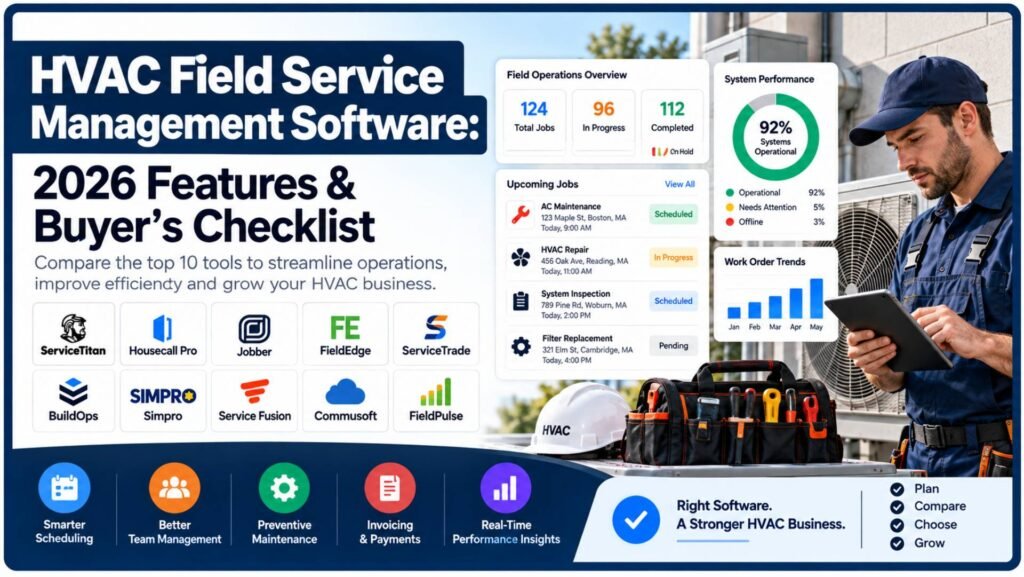
Choosing the right HVAC Field Service Management Software can help service businesses coordinate technicians, appointments, customer records, estimates, invoices, and day-to-day field work from one system.
The market is crowded and prices vary enormously, from around $30 a month for a solo operator to several hundred dollars per technician for enterprise platforms with six-figure implementation projects. This guide compares the Top HVAC Software in 2026 based on published vendor pricing, aggregated ratings from G2 and Capterra, and independent trade-press and buyer-guide coverage. None of these platforms were tested hands-on for this piece; every pricing figure and rating below is sourced from vendor pricing pages or independent review platforms rather than personal experience, and figures are noted as approximate where vendors don’t publish pricing directly.
How This List Was Put Together
Selection prioritised HVAC Service Management Software with a genuine HVAC or trades specialisation rather than generic project management software repurposed for field work. We also considered independent review volume and coverage across the full range of HVAC business sizes, from solo operators to enterprise commercial contractors, since no single platform fits every shop. Pricing changes frequently in this category and several vendors quote only through a sales call, so treat every figure below as a starting point for your own research rather than a locked-in price.
Quick Comparison
| Software | Best For | Starting Price | G2 / Capterra Rating |
|---|---|---|---|
| ServiceTitan | Large residential HVAC operations (10+ techs) | ~$245–$398/tech/month, quote-only | 4.5 / 4.4 |
| Housecall Pro | Small to mid-size residential HVAC teams | $59/month (1 user, annual) | 4.3 / 4.7 |
| Jobber | Solo operators and small crews (2–20 techs) | $39/month (1 user) | 4.5 / 4.6 |
| FieldEdge | HVAC shops on QuickBooks Desktop | ~$100–$125/user/month, quote-only | 4.2 / 4.3 (approx.) |
| ServiceTrade | Commercial HVAC, mechanical and fire/life-safety contractors | Quote-only | 4.5 / 4.6 (approx.) |
| BuildOps | Commercial MEP contractors mixing service and project work | ~$150–$300/user/month, quote-only | 4.6 / 4.5 (approx.) |
| Simpro | Mid-market commercial contractors (10–500 techs) | ~$70–$300/user/month depending on tier | 4.1 / 4.2 (approx.) |
| Service Fusion | Growing teams wanting unlimited users at a flat rate | $208–$245/month flat (all users) | 3.9 / 4.4 (approx.) |
| Commusoft | Mid-size HVAC and trades businesses wanting polished workflows | Quote-only, ~$100–$200/user/month | 4.7 / 4.7 |
| FieldPulse | Small to mid-size teams (2–20 techs) upgrading from spreadsheets | ~$49–$99/month for teams | 4.7 / 4.8 (approx.) |
Ratings and pricing verified against vendor pages and G2/Capterra listings between April and August 2026. Several vendors don’t publish exact figures publicly; where a source describes a rating or price as approximate rather than vendor-confirmed, that’s noted above and pricing should be confirmed directly with the vendor before budgeting.
1. ServiceTitan
ServiceTitan is one of the more comprehensive HVAC Field Service Solutions in this comparison, and it’s built for scale: dispatch, CRM, invoicing, marketing attribution, call recording, service agreements and payroll all sit inside one system. Its dispatch board is consistently the most praised feature in independent reviews, with reviewers pointing to real-time technician visibility and the ability to reshuffle schedules without phone calls. The trade-off is cost and complexity — pricing is quote-only but independent teardowns put it at roughly $245 to $398 per technician per month for smaller operations, climbing to $500 to $1,200 monthly for mid-size teams, before add-ons like Marketing Pro or Fleet Pro. Implementation commonly takes months, and multiple reviewers describe a genuine learning curve around the pricebook and custom reporting.
Best for: growth-stage and enterprise HVAC operations with 10 or more technicians and dedicated office staff to manage the platform.
Worth knowing: setup fees are commonly reported in the $5,000 to $50,000 range depending on scope, and there’s no free trial.
2. Housecall Pro
Housecall Pro is particularly relevant for small and growing businesses comparing HVAC Scheduling and Dispatch Software. Its dispatch calendar and mobile app are what reviewers most often say they’d miss if they switched, and the automated “on my way” customer text is a frequently cited favourite. Pricing is published and tiered: Basic runs $59 a month billed annually for one user, Essentials $149 a month for up to five users, and Max $299 a month for larger teams, with month-to-month rates running higher. There’s a notable gap between its G2 score (4.3) and Capterra score (4.7); the day-to-day platform experience is rated highly, but G2 reviews skew toward users who ran into billing or support friction after onboarding, worth reading directly before committing.
Best for: small to mid-size residential HVAC teams that want an accessible alternative to enterprise platforms.
3. Jobber
Jobber is the software most reviewers position as the best value for small teams — description after description calls it roughly 80% of what ServiceTitan does at a fraction of the price. It covers quoting, scheduling, invoicing and a customer-facing Client Hub where clients approve quotes and pay online, and it consistently scores around 4.5 on both G2 and Capterra across thousands of reviews. Pricing starts at $39 a month for a single user (Core), rising through Connect and Grow tiers to Plus at $599 a month for larger teams, with each additional user costing roughly $29 a month on top of the base plan. Reviewers note it handles straightforward service-call dispatch well but lacks the AI-assisted or skill-based technician assignment found in some higher-end competitors.
Best for: solo operators and small crews (roughly 2 to 20 technicians) who want to be live within days rather than months.
4. FieldEdge
FieldEdge is one of the established HVAC Business Management Tools in this comparison and built much of its reputation on a genuinely two-way, real-time QuickBooks Desktop sync. That differentiator matters to the sizeable number of HVAC and plumbing shops still on Desktop rather than QuickBooks Online, where competitors’ integrations are often one-way or Online-only. Its Coolfront flat-rate pricebook and MarketingEdge service-agreement automation are frequently highlighted as its strongest workflows. Pricing isn’t published; independent sources consistently estimate $100 to $125 per user per month, with roughly $500 to $2,000 or more in setup fees, and no free trial. Because pricing is per user rather than per truck, office-heavy teams can see costs climb faster than technician headcount alone would suggest.
Best for: established HVAC and plumbing shops of 5 to 50 technicians that are committed to QuickBooks, particularly QuickBooks Desktop.
5. ServiceTrade
Among the Field Service Software for HVAC Companies covered here, ServiceTrade is particularly focused on commercial HVAC, mechanical and fire/life-safety contractors running recurring maintenance agreements rather than the residential service-call model most platforms on this list default to. It handles code-compliant inspections with report generation, asset and service history at the equipment level, and a customer portal designed to build trust with commercial clients managing large facility portfolios. Reviewers note it integrates with construction-oriented accounting platforms including Sage 100, Sage 300 and ComputerEase, alongside QuickBooks. Where it’s a weaker fit is for contractors whose revenue comes primarily from selling and installing new systems rather than servicing existing commercial equipment.
Best for: commercial HVAC, mechanical and fire-protection contractors weighted toward recurring service and maintenance contracts.
6. BuildOps
BuildOps belongs among the Top HVAC Management Platforms worth considering for commercial contractors that need deeper coordination across service, projects, technicians, assets, and back-office operations.
BuildOps was built from the ground up for commercial MEP contractors — HVAC, electrical, plumbing and refrigeration — rather than adapted from a residential tool, and reviewers consistently credit it as a stronger fit than ServiceTitan for commercial-only operations doing both service and new-construction project work. Its planning board factors in technician skills, certifications and location, and completed projects flow directly into service records as equipment becomes trackable assets for future maintenance agreements. Pricing is quote-only; independent estimates put it around $150 to $300 per user per month, sometimes higher for construction-heavy feature sets, with reviewers describing it as well suited to contractors running 15 or more technicians across a mix of project and service revenue.
Best for: commercial HVAC and mechanical contractors mixing preventive maintenance contracts with larger construction and build work.
7. Simpro
Simpro is an Australian-founded platform with a strong UK and US presence, built for trade businesses handling both service calls and larger project-based work. For companies evaluating HVAC Technician Management Software, its combination of quoting, job costing, real-time inventory, purchase orders, scheduling and dispatch can support more complex field operations. It’s frequently recommended for mid-market commercial contractors, generally cited as strongest for operations between roughly 10 and 500 technicians managing multi-phase work rather than pure demand-service HVAC calls. Pricing isn’t published and varies substantially by source, with figures ranging from around $70 to $300 per user per month depending on tier and modules.
Best for: established trade businesses combining service work with larger commercial projects, particularly outside the US where Simpro has a longer track record.
8. Service Fusion
Service Fusion’s defining feature is pricing structure rather than any single workflow: every tier includes unlimited users for one flat monthly fee, rather than charging per technician. Independent reviews describe this as most advantageous once a team passes roughly 12 to 15 technicians, where per-user competitors start costing noticeably more; smaller teams under about 10 technicians are generally reported to save money on per-user platforms like Jobber or Housecall Pro instead. Reported pricing tiers vary somewhat by source, but most place the entry Starter plan in the $208–$245 a month range (annual billing), rising through Plus and Pro tiers to $500–$600+ a month, all with unlimited users. It maintains two-way QuickBooks Desktop and Online sync, a point of difference as several competitors have dropped Desktop support, though multiple reviews flag the mobile app as dated compared to Jobber’s or Housecall Pro’s.
Best for: growing HVAC, plumbing and electrical teams — particularly 12 or more technicians — that want to avoid per-seat pricing as headcount rises.
9. Commusoft
Commusoft, founded in London and still headquartered there with a Chicago office serving US customers, is one of the higher-rated platforms in this category on both major review sites, posting around 4.7 out of 5 on both G2 and Capterra. Independent reviewers highlight its customer-journey workflows and quoting and proposal tools as particularly polished, and its accounting integrations extend to Xero and Sage alongside QuickBooks — a genuine advantage for UK-based HVAC and trades businesses, where Xero and Sage are far more common than QuickBooks. Pricing isn’t published; industry estimates place it at roughly $100 to $200 per user per month depending on plan and feature selection.
Best for: mid-size HVAC and trades businesses (roughly 5 to 100 technicians) wanting strong customer communication tools, and UK-based contractors wanting native Xero or Sage integration rather than a QuickBooks-only platform.
10. FieldPulse
FieldPulse is worth considering when comparing the best Software for HVAC Contractors that have outgrown spreadsheets or very basic tools but are not ready for enterprise-level cost and complexity. It sits between Jobber and ServiceTitan in many independent comparisons, offering more structure than the simplest small-business tools while remaining faster and less expensive to deploy than enterprise platforms. Its standout feature, ClearPath, walks technicians through defined job stages so office staff can enforce consistent processes without constant oversight. Published entry pricing starts around $49 a month for a solo user, with team plans commonly reported in the roughly $99 to $249 a month range.
Best for: small to mid-size HVAC teams (roughly 2 to 20 technicians) outgrowing spreadsheets or basic tools but not ready for ServiceTitan-level cost and complexity.
Choosing Between Them
Choosing between HVAC Field Service Management Tools depends far more on team size and business model than on any single feature. Solo operators and very small crews are consistently best served by Jobber or FieldPulse, both of which prioritise fast setup and low starting cost over depth. Solo operators and very small crews are consistently best served by Jobber or FieldPulse, both of which prioritise fast setup and low starting cost over depth. Established residential HVAC shops running five to fifty technicians have the widest choice — Housecall Pro, FieldEdge, Service Fusion and Commusoft all compete directly in this range, and the deciding factor is usually which accounting platform you’re already on (QuickBooks Desktop points toward FieldEdge or Service Fusion; Xero or Sage points toward Commusoft) rather than any dramatic difference in core scheduling and dispatch capability. Commercial contractors running recurring maintenance agreements or mixing service with construction project work are generally better served by ServiceTrade, BuildOps or Simpro, all of which were built around commercial workflows rather than adapted from residential tools. And large residential operations with dedicated office staff and the budget to match are the clearest fit for ServiceTitan, which remains the deepest platform in the category but also the most expensive and complex to implement.
Whichever platform you’re considering, it’s worth requesting a live demo with your own real-world scenario — a typical dispatch day, a service agreement renewal, an emergency call-out — rather than relying on a generic sales walkthrough, and asking existing customers of a similar size directly about implementation time and ongoing support quality, since that’s where independent reviews most consistently diverge from vendor marketing.
FAQs
What’s the difference between field service management software and a generic scheduling app?
FSM software built for trades typically bundles dispatch, mobile technician access, invoicing, customer history and often service-agreement or equipment tracking into one connected system, rather than treating scheduling as a standalone calendar. Platforms designed specifically for HVAC also tend to include trade-specific tools like flat-rate pricebooks and equipment nameplate scanning that generic project management tools don’t offer.
Is the most expensive platform always the best choice?
No. Independent reviews consistently show smaller HVAC teams getting better value and faster adoption from mid-tier platforms like Jobber, Housecall Pro or FieldPulse than from enterprise tools like ServiceTitan, which several reviewers explicitly describe as poor value below roughly ten technicians. Match the platform to your team size and complexity rather than assuming scale equals quality.
Do these platforms integrate with QuickBooks?
Most do, but the depth varies significantly. FieldEdge and Service Fusion are generally rated strongest for QuickBooks Desktop, with genuine two-way sync; several other platforms, including Jobber, support QuickBooks Online only. If you’re not planning to move off Desktop, confirm this specifically before choosing.
What should a UK-based HVAC or trades business consider that a US buyer might not?
Most platforms on this list are US-founded and built primarily around QuickBooks integration; Commusoft is a UK-founded exception with native Xero and Sage support, which will matter more than any other single factor for a UK contractor not using QuickBooks. Simpro also has an established UK presence. It’s worth confirming currency, VAT handling and accounting-software compatibility directly with any US-based vendor before signing up.
How long does implementation typically take?
This varies enormously by platform. Jobber, Housecall Pro and FieldPulse are generally described as usable within days to a couple of weeks. Enterprise platforms like ServiceTitan, BuildOps and Simpro are more commonly reported to take anywhere from several weeks to a few months for full implementation, particularly for larger teams or complex data migration.
This comparison reflects publicly available vendor pricing and aggregated third-party review data as of 2026, drawn from G2, Capterra and independent field service software review sites. No hands-on testing was conducted for this piece, and pricing for several platforms is quote-only, so figures above are independent estimates rather than vendor-confirmed prices in every case. Software pricing and features in this category change frequently — confirm current terms directly with each vendor before purchasing.