
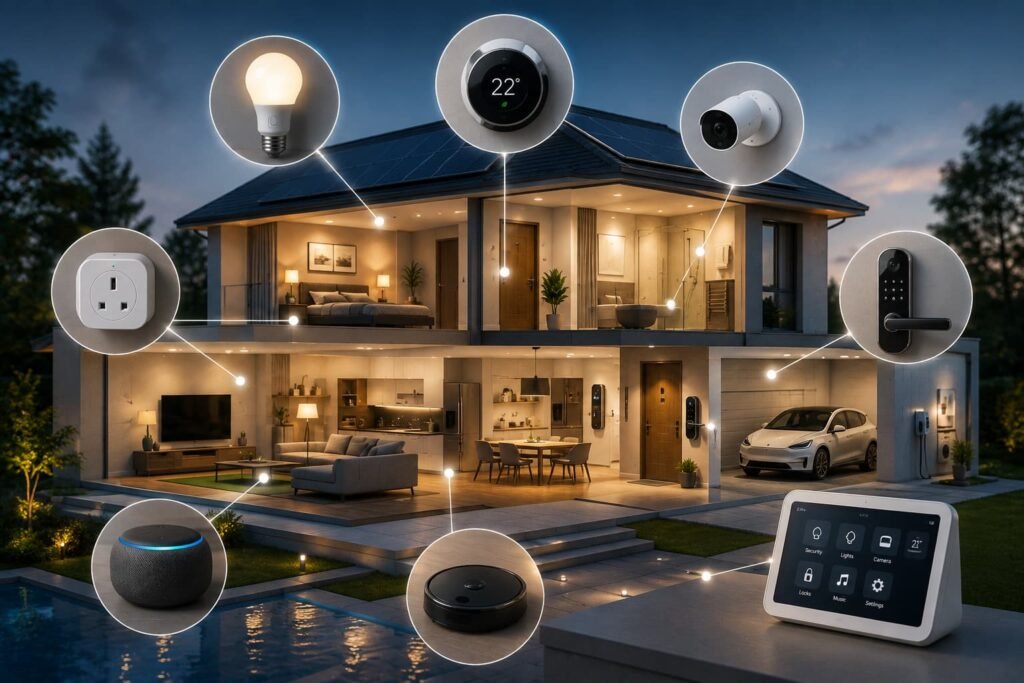
Smart-home technology is supposed to make life easier. Yet it is remarkably easy to spend hundreds of pounds on connected gadgets that add another app, another account and another notification without solving a real household problem.
The smart-home market in 2026 is becoming more practical. Matter is improving communication between competing ecosystems, Thread is giving compatible devices a low-power local network, and established platforms such as Apple Home, Amazon Alexa, Google Home and Samsung SmartThings are becoming easier to mix.
That does not mean every new connected product deserves a place in your house.
For this guide, we prioritised devices that perform useful jobs repeatedly. The strongest products can help control heating, automate lighting, monitor electricity use, reduce cleaning time or improve front-door security. Novelty features mattered far less than reliability, value and long-term usefulness.
After comparing products across the main smart-home categories, these are the five smart home devices we believe make the strongest case for UK households in 2026.
Key Takeaways
- tado° X Smart Thermostat is our best overall choice because heating control can improve comfort while helping households manage energy use.
- Philips Hue Bridge Pro is the strongest choice for serious whole-home smart lighting.
- Eve Energy is the easiest low-cost upgrade, offering Matter, Thread and electricity monitoring for around £40.
- eufy Omni C28 can remove a substantial amount of routine vacuuming and mopping from busy households.
- Aqara Doorbell Camera Hub G410 combines front-door security with useful smart-home hub functions and local storage options.
- Matter improves compatibility, but it does not mean every product feature works identically in every smart-home ecosystem.
- Purchase price is only part of the cost. Subscriptions, replacement parts, batteries, hubs and accessories should all influence a buying decision.
How We Chose the Best Smart Home Devices
This ranking focuses on practical household benefit rather than technical novelty.
We assessed devices using the following editorial framework:
| Ranking Factor | Weight |
|---|---|
| Practical everyday usefulness | 25% |
| Reliability and performance | 20% |
| Value for money | 15% |
| Smart-home compatibility | 15% |
| Ease of installation and use | 10% |
| Privacy and security | 5% |
| Automation potential | 5% |
| Long-term support and future-readiness | 5% |
Also, we reviewed current manufacturer specifications, UK pricing, ecosystem support, installation requirements, subscriptions and independent professional reviews. We did not perform new hands-on laboratory testing for this article, so product-performance comments are based on documented specifications, professional testing and clearly identified user feedback.
The result is deliberately varied. There is little value in recommending five expensive gadgets that solve the same problem.
Best Smart Home Devices of 2026 — Quick Verdict
1. tado° X Smart Thermostat — Best Smart Home Device Overall
2. Philips Hue Bridge Pro — Best for Smart Lighting
3. Eve Energy — Best-Value Smart Home Upgrade
4. eufy Omni C28 — Best for Automated Cleaning
5. Aqara Doorbell Camera Hub G410 — Best for Front-Door Security
Best Smart Home Devices of 2026 Compared
| Rank | Device | Best For | UK Price* | Matter | Thread | Alexa | Google Home | Apple Home | Subscription |
|---|---|---|---|---|---|---|---|---|---|
| 1 | tado° X Smart Thermostat Starter Kit | Heating | £119.99 | Yes | Yes | Yes | Yes | Yes | Optional |
| 2 | Philips Hue Bridge Pro | Lighting | £89.99, lights extra | Yes, via Bridge | No for traditional Hue lighting network | Yes | Yes | Yes | No for core lighting |
| 3 | Eve Energy | Power monitoring | £39.95–£39.99 | Yes | Yes | Yes | Yes | Yes | No |
| 4 | eufy Omni C28 | Cleaning | £649 | No | No | Yes | Yes | No HomeKit | No for core cleaning |
| 5 | Aqara Doorbell Camera Hub G410 | Security | £129.99 RRP | Hub/controller support | Border router | Yes | Yes | Yes | Optional |
*Prices checked on 25 August 2026. Promotions and retailer pricing can change.
Current official UK listings show the wired tado° X starter kit at £119.99, Philips Hue Bridge Pro at £89.99 and eufy Omni C28 at £649. Eve Energy is listed at £39.95 by Apple UK, while Aqara’s European store lists the G410 at £129.99 before retailer promotions.
1. tado° X Smart Thermostat — Best Smart Home Device Overall
Why It Made the List
Smart heating solves a more important problem than most connected household gadgets.
A well-configured thermostat can improve comfort, prevent rooms from being heated unnecessarily and automate one of the largest recurring energy uses in many UK homes.
The Wired Smart Thermostat X Starter Kit is currently listed at £119.99 and includes the Bridge X Thread border router. tado° says the thermostat works with most compatible boiler and heat-pump systems using relay or OpenTherm control.
What It Does
The tado° X system replaces conventional heating controls with app-controlled thermostats and optional smart radiator valves.
You can create heating schedules, control temperatures remotely and expand the system so different rooms operate independently.
For larger homes, smart radiator valves are where the system becomes particularly useful. There is little reason to heat an unused bedroom to the same temperature as the living room.
Smart-Home Compatibility
tado° X supports Matter over Thread and works with major smart-home platforms.
The supplied Bridge X can operate as the Thread border router, although compatible third-party Thread border routers can also form part of a Matter installation.
That is a useful improvement over older smart-home products that depend entirely on proprietary hubs.
What We Like
The biggest advantage is simple: the system deals with a household function that matters every day.
tado° has also retained standard scheduling and smart control without forcing every user into a subscription.
More advanced automation is available through its optional AI Assist service. tado° says AI Assist can automate geolocation-based heating, learn room heating characteristics, react to detected open windows and provide more detailed energy information.
Local behaviour is useful too. A smart heating system should not become useless because broadband temporarily stops working.
What Could Be Better
A complete multi-room system can become expensive once several smart radiator valves are added.
The X generation also needs careful consideration from owners of older tado° equipment because it represents a newer platform rather than a simple drop-in expansion for every previous installation.
Installation difficulty depends heavily on the existing heating system. Some users will be comfortable replacing a thermostat; others should use a qualified professional.
Pros
- Matter and Thread support
- Useful every day rather than occasionally
- Strong fit for UK heating systems
- Expandable room-by-room control
- Basic schedules do not require a paid plan
Cons
- Whole-home installations become expensive
- Advanced automation sits behind an optional subscription
- Boiler compatibility must be checked before purchase
Best For
Homeowners who want better heating control, especially properties with rooms that are used at different times.
Skip It If
Your existing thermostat already provides effective zoning and automation, or you have an older smart-heating installation that would require replacing substantial working hardware.
2026 Verdict
Our best smart home device overall.
The tado° X does something that matters: it manages comfort and heating rather than simply adding remote control to an appliance that never needed it.
2. Philips Hue Bridge Pro — Best for Smart Lighting
Why It Made the List
Smart lighting sounds simple until it grows beyond one or two bulbs.
A useful lighting system should be able to automate rooms, respond to sensors, follow schedules, create routines and continue behaving predictably without constant attention.
That is where Philips Hue remains strong.
The current Hue Bridge Pro costs £89.99 and supports more than 150 lights and over 50 accessories, according to Philips Hue’s UK listing. It works with Apple Home, Alexa, Google Assistant and Samsung SmartThings.
What It Does
The Bridge Pro becomes the control centre for compatible Philips Hue lights, switches, sensors and other accessories.
Instead of loading dozens of individual devices onto your Wi-Fi network, traditional Hue products communicate primarily with the bridge using Zigbee.
Matter Compatibility
Both the Hue Bridge and Bridge Pro support Matter.
This means compatible Hue lights connected through the bridge can be exposed to other Matter ecosystems.
There is an important limitation: Matter support comes through the bridge. Traditional Hue bulbs connected through the Hue system are not suddenly Thread bulbs.
Philips also notes that certain specialised functions are not exposed through Matter.
That distinction is important when comparing smart-home products in 2026. “Supports Matter” and “all features work everywhere” are not the same statement.
What We Like
Hue’s biggest strength is maturity.
There are cheaper smart bulbs, but Hue offers an unusually broad combination of lights, switches, motion sensors and automation options.
The Bridge Pro significantly increases capacity compared with the standard bridge, making it more relevant for people planning lighting across a whole property.
Philips Hue also issued a firmware fix in April 2026 for a Bridge Pro Matter connectivity problem. That issue illustrates both sides of smart-home ownership: software bugs can affect interoperability, but an actively maintained platform can correct them through firmware.
What Could Be Better
The £89.99 price is only the beginning.
Bulbs, switches, sensors, outdoor lighting and decorative products can make a large Hue system expensive.
Someone planning three smart bulbs probably does not need the Bridge Pro. The cheaper standard bridge remains more sensible for modest installations.
Pros
- Excellent whole-home lighting ecosystem
- Matter support through the bridge
- Works with major smart-home platforms
- High device capacity
- Strong automation options
Cons
- Premium pricing
- Lights and accessories cost extra
- Bridge Pro is unnecessary for very small systems
- Hue’s underlying lighting network is still primarily Zigbee
Best For
People building a reliable multi-room lighting system with sensors, switches and automations.
Skip It If
You only want one or two inexpensive app-controlled bulbs.
2026 Verdict
Hue earns second place because good lighting automation becomes almost invisible once configured correctly.
Lights turning on at the right brightness when needed is far more useful than repeatedly opening an app to control them.
3. Eve Energy — Best-Value Smart Home Upgrade
Why It Made the List
Not every worthwhile smart-home purchase needs to cost hundreds of pounds.
Eve Energy costs about £39.95–£39.99 in the UK and turns a standard socket into a remotely controlled outlet with electricity monitoring.
That makes it one of the easiest ways to add genuinely useful automation to an existing appliance.
What It Does
Eve Energy can turn suitable plugged-in equipment on and off, follow schedules and report electricity consumption.
Possible uses include:
- Scheduling lamps
- Switching office equipment off overnight
- Monitoring the consumption of appliances
- Cutting power to devices left on unnecessarily
- Adding ordinary equipment to broader home routines
Smart-Home Compatibility
Eve Energy supports Matter over Thread.
Apple’s UK listing confirms support for Matter and Thread, alongside control through major ecosystems.
Thread is particularly well suited to small smart-home accessories because it creates a low-power mesh network rather than requiring every device to communicate directly over Wi-Fi.
A compatible Thread border router is required for a complete Thread-based setup.
What We Like
Privacy is one of Eve Energy’s stronger points.
The device does not require an Eve cloud account for its core operation. That reduces dependence on another manufacturer’s remote server and makes it a good example of where local-first smart-home design can work well.
There is no mandatory subscription.
Energy monitoring adds another practical reason to own it. A smart plug that only turns something on from a phone can feel unnecessary. A plug that also shows what an appliance consumes is far easier to justify.
What Could Be Better
Around £40 is expensive for one smart socket.
Buy six or eight of them and the cost starts approaching that of much more substantial smart-home hardware.
Feature presentation can also vary between Matter platforms, particularly with detailed energy information.
Pros
- Matter and Thread
- Energy monitoring
- No mandatory subscription
- Strong privacy approach
- Easy installation
- Works with existing appliances
Cons
- Expensive compared with basic Wi-Fi plugs
- Best experience requires suitable Matter/Thread infrastructure
Best For
Anyone wanting to start a smart home without replacing major appliances.
Skip It If
You only require basic scheduled switching and can get the same result from a much cheaper conventional timer.
2026 Verdict
The best-value upgrade in this ranking.
Eve Energy is small, relatively affordable and useful enough to remain valuable after the novelty of controlling a plug from a phone disappears.
4. eufy Omni C28 — Best for Automated Cleaning
Why It Made the List
Robot vacuums have one major advantage over many smart devices: they can remove part of a repetitive household job.
The eufy Omni C28 is a 2026 robot vacuum and mop priced at £649 in the UK.
That is not cheap, but it sits well below some flagship cleaning robots costing more than £1,000.
What It Does
The C28 combines vacuuming and roller-mop cleaning with a docking station that handles several maintenance tasks.
Manufacturer specifications include:
- 15,000Pa claimed suction
- HydroJet self-cleaning roller mop
- Automatic dust emptying
- Mop washing
- Water refilling
- Hot-air mop drying
- Automatic brush detangling
- LiDAR and laser-assisted navigation
Those are manufacturer specifications rather than independent performance guarantees.
Smart-Home Compatibility
This is where the C28 falls behind the products above it.
eufy’s support documentation confirms Alexa and Google Assistant support but says the C28 does not currently support Matter or Apple HomeKit.
For a £649 connected appliance in 2026, broader ecosystem support would have strengthened its position.
What We Like
Its practical value is obvious.
A robot that automatically vacuums and mops several times each week can return meaningful time to a household.
The dock deals with much of the unpleasant maintenance that made early robot vacuums feel less automatic than their advertising suggested.
It also uses navigation sensors rather than depending on a conventional RGB household camera for its core navigation system, which may appeal to people uncomfortable with roaming indoor cameras.
What Could Be Better
Robot vacuums remain maintenance devices, not maintenance-free devices.
Dust bags, brushes, filters and mop components eventually need replacement. eufy’s own accessory bundles illustrate the ongoing consumable cost.
Floor layouts matter too. Cables, unusually shaped furniture, raised thresholds and clutter can still create problems.
Pros
- Automates a genuinely repetitive household task
- Vacuums and mops
- Self-emptying and self-cleaning dock
- Less expensive than many flagship robots
- Automatic brush detangling
Cons
- £649 purchase price
- No Matter support
- No Apple HomeKit support
- Replacement consumables add cost
- Does not eliminate every manual cleaning job
Best For
Busy households, pet owners and homes with substantial hard flooring.
Skip It If
Your home has many stairs, cluttered floors or a layout that requires frequent manual vacuuming regardless of robot navigation.
2026 Verdict
The C28 is worth considering because it can save actual household time.
Its smart-home compatibility is ordinary, but its ability to automate cleaning matters more than having another Matter logo.
5. Aqara Doorbell Camera Hub G410 — Best for Front-Door Security
Why It Made the List
The Aqara Doorbell Camera Hub G410 combines several devices in one package.
It is a video doorbell, indoor chime, Zigbee hub, Matter controller and Thread border router.
Aqara’s European store currently lists it at £129.99, while UK specialist retailers may run lower promotional pricing.
What It Does
The G410 records front-door video and can alert household members to visitors or detected activity.
Aqara lists features including:
- 2K video in its native ecosystem
- 175-degree field of view
- Local face recognition
- Dual-band Wi-Fi
- microSD storage up to 512GB
- Wired or AA-battery operation
- Zigbee hub
- Thread border router
- Matter controller
Smart-Home Compatibility
The G410 works with Apple Home, Alexa, Google Home and SmartThings, making it one of the more flexible doorbells for mixed smart homes.
There is an important Matter distinction.
The product acts as a Matter controller and Thread border router. That should not be interpreted as meaning every camera function is universally exposed through Matter.
Aqara also states that HomeKit Secure Video is limited to a lower video resolution than the maximum available inside Aqara’s own system.
Subscription and Storage
One of its biggest benefits is that cloud storage is not compulsory.
A microSD card can be installed in the indoor chime, keeping the storage medium away from someone standing outside the house.
Optional cloud services are available, and Apple users can use HomeKit Secure Video with the appropriate iCloud plan.
Hardwiring unlocks the strongest setup because continuous recording requires constant power.
Privacy and Security
Cameras deserve more scrutiny than smart bulbs and plugs because they can collect sensitive household information.
The G410 offers local face recognition and local microSD storage, reducing the need to send every function to a remote cloud service.
Buyers should still keep firmware updated, use strong account security and review exactly which integrations receive access to camera data.
What Could Be Better
Weather protection is one concern.
Independent testing has highlighted the G410’s modest IPX3 rating, meaning placement deserves attention if the door is exposed directly to heavy weather.
Battery use is another consideration. Aqara’s claimed battery life depends on a limited number of daily activations, so a busy entrance may require more frequent replacements.
Hardwired installation therefore makes a stronger case where possible.
Pros
- Local storage
- No compulsory cloud subscription
- Apple Home, Alexa and Google support
- Matter controller
- Thread border router
- Built-in smart-home hub functions
Cons
- Modest weather-resistance rating
- Uses six AA batteries when not wired
- Battery life depends heavily on activity
- Some ecosystem features run at reduced capability
Best For
Households wanting a video doorbell that can also become part of a wider Aqara, Apple Home or Matter setup.
Skip It If
Your front door is heavily exposed to rain and you need a completely wireless doorbell with exceptionally long battery life.
2026 Verdict
The G410 offers more than a conventional doorbell and avoids forcing buyers into cloud storage for basic usefulness.
We rank it fifth because reliability and environmental durability matter more for a security device than extra smart-home features.
Smart Home Upgrades You Probably Do Not Need
Not every connected device becomes better simply because it has Wi-Fi.
Before buying any smart appliance, ask whether connectivity changes what the product can meaningfully do.
App-Controlled Kitchen Gadgets
A kettle, toaster or coffee maker that still requires someone to fill it, prepare ingredients and clean it may gain very little from remote app control.
There are exceptions. Scheduling, safety functions or genuine automation can make some products useful. Remote control by itself is a weak reason to replace working equipment.
Subscription-Heavy Devices
A cheap camera can become expensive when essential recording features require a monthly plan.
Always calculate the three-year ownership cost, not just the checkout price.
Smart Versions of Rarely Used Products
Automation creates the most value when it removes a frequent action.
There is little reason to pay a large premium to connect something you use twice a month.
Devices Trapped in Ageing Ecosystems
Before committing to a proprietary hub, check whether the manufacturer still supports it, whether new products are being released and whether the hardware can interact with Matter or major third-party platforms.
Connected Appliances With No Useful Automation
Being able to see washing-machine progress on a phone can be convenient.
It is not necessarily worth replacing a reliable washing machine solely to gain that feature.
What to Look for When Buying Smart Home Devices in 2026
Ecosystem Compatibility
Decide which ecosystem will act as your main control layer.
For most households this will be Apple Home, Alexa, Google Home, SmartThings or a more advanced system such as Home Assistant.
Avoid creating five separate islands that require five apps for routine control.
Matter Support
Matter is intended to make products from different brands easier to use together.
It is useful, but it is not magic.
A Matter-compatible device may expose basic functions such as switching or temperature control while retaining advanced settings in its manufacturer’s app.
Check the functions you actually need.
Thread Support
Thread is a low-power mesh networking technology used by many Matter devices.
It can improve responsiveness and reduce dependence on conventional Wi-Fi, but the system needs a compatible Thread border router.
Some smart speakers, hubs and products such as Aqara’s G410 or tado’s Bridge X can perform this role.
Local Versus Cloud Control
Local operation can make a smart home more resilient.
Lights, heating schedules and automations should ideally continue performing basic jobs when broadband fails.
Cloud services remain useful for remote access, backups and AI features, but complete cloud dependence creates another point of failure.
Privacy and Security
The level of concern should match the type of device.
A smart bulb knows far less about your private life than an indoor camera.
For security devices, check:
- Local storage options
- Encryption
- Two-factor authentication
- Account controls
- Camera and microphone behaviour
- Firmware-update history
- Cloud-storage policies
Subscription Costs
A £150 device with a £10 monthly subscription costs £510 over three years before accounting for batteries or accessories.
That may still be worth paying for, but it should be part of the buying decision from the beginning.
Installation
Plugs and bulbs are simple.
Thermostats, wired switches and hardwired doorbells may involve mains electricity, heating-system wiring or transformers.
Use a qualified installer where appropriate.
Reliability
The best smart-home automation is one you stop thinking about.
If turning on a light becomes a troubleshooting exercise, a normal switch was smarter.
Long-Term Support
Hardware can last for years. Apps and cloud services are less predictable.
Look for established manufacturers, active firmware development and standards-based connectivity where possible.
Ask Whether It Actually Saves Time
This is perhaps the most useful buying test.
- Does the device remove a repeated job?
- Does it reduce wasted energy?
- Does it improve security?
- Does it simplify control?
If the main answer is “I can now do the same thing from my phone”, think carefully before paying a premium.
Which Smart Home Device Should You Buy?
Buy the tado° X Smart Thermostat if…
You want a practical whole-home improvement and better control over heating.
Buy Philips Hue Bridge Pro if…
You plan to automate lighting across several rooms and expect to add switches, sensors and more lights over time.
Buy Eve Energy if…
You want an inexpensive first smart-home upgrade with Matter, Thread and electricity monitoring.
Buy the eufy Omni C28 if…
Your priority is reducing time spent vacuuming and mopping rather than building the perfect cross-platform smart-home ecosystem.
Buy the Aqara G410 if…
You need a video doorbell and like the idea of gaining a Matter controller, Thread border router and Aqara hub at the same time.
Final Buying Recommendations
Best Overall: tado° X Smart Thermostat
It solves a real household problem, has strong UK relevance and combines useful automation with modern Matter and Thread connectivity.
Best Value: Eve Energy
Around £40 buys local-friendly smart control, electricity monitoring and broad Matter compatibility without another monthly subscription.
Best for Smart Lighting: Philips Hue Bridge Pro
It makes the most sense for larger lighting installations where reliability, sensors and automation matter more than getting the cheapest bulbs.
Best for Cleaning: eufy Omni C28
The C28’s value comes from removing repetitive work. That matters more than its relatively limited smart-home integrations.
Best for Security: Aqara Doorbell Camera Hub G410
Local storage and broad ecosystem support make it appealing, especially when hardwired and installed in a reasonably sheltered location.
FAQs
What is the best smart home device to buy in 2026?
Based on our research, the tado° X Smart Thermostat is the strongest overall choice for many UK households because it controls a frequently used home system and may help households manage heating more efficiently. The right choice still depends on the problem you want to solve.
Is Matter important when buying smart home devices?
Matter is increasingly valuable because it makes it easier for devices from different manufacturers to work across major smart-home platforms. It should not be the only buying criterion, since advanced features can remain exclusive to a manufacturer’s own app.
What is the difference between Matter and Thread?
Matter is a smart-home interoperability standard that defines how compatible devices communicate at the application level.
Thread is a low-power mesh networking technology that can carry Matter communications.
A device can support Matter without using Thread.
Do Matter devices work without the internet?
Many Matter functions can operate locally, but the exact behaviour depends on the product and ecosystem. Remote control, voice assistants, cloud storage and manufacturer services may still require an internet connection.
Which smart home device offers the best value?
For buyers who want a low-cost starting point, Eve Energy is our best-value choice. It costs around £40 and combines remote switching, energy monitoring, Matter and Thread without a compulsory subscription.
Are smart thermostats worth buying in the UK?
They can be worthwhile for homes where heating schedules, room usage or occupancy vary. Savings are never guaranteed because insulation, boiler efficiency, household behaviour and existing controls all affect energy consumption.
Do smart-home devices require subscriptions?
Many do not. Hue lighting and Eve Energy work without mandatory subscriptions for their core functions. tado° offers optional paid automation, while security-camera companies often charge for additional cloud storage or advanced services.
Is a robot vacuum really a smart-home essential?
It is not essential for every household, but it can provide more practical value than many inexpensive connected gadgets because it performs a physical task repeatedly. Homes with pets, hard flooring or frequent cleaning needs benefit most.
Conclusion
The smartest home is not the one with the largest number of connected products.
It is the one where technology quietly removes work, reduces waste or improves security.
That is why the five products in this guide perform very different jobs. The tado° X manages heating. Philips Hue automates lighting. Eve Energy gives ordinary appliances smarter power control. The eufy C28 takes on routine floor cleaning. Aqara’s G410 watches the front door while doubling as smart-home infrastructure.
Matter and Thread are making mixed-brand smart homes easier to build, but standards should support a buying decision rather than dictate it.
Start with the problem you want to solve.
Then check compatibility, long-term costs, reliability and privacy.
Only then should you decide which connected device deserves a place in your home.
Editorial Disclaimer
Prices, promotions, stock levels, subscriptions, compatibility and product features can change after publication. Information in this article was checked against manufacturer documentation, current UK listings and independent review evidence available at the time of writing. This article is intended as general consumer information and does not guarantee energy savings, product performance or compatibility with every home installation. Check the manufacturer’s latest specifications and compatibility guidance before purchasing. No new hands-on product testing was conducted specifically for this comparison.
Last Checked: 25 August 2026 | Review Due: November 2026