
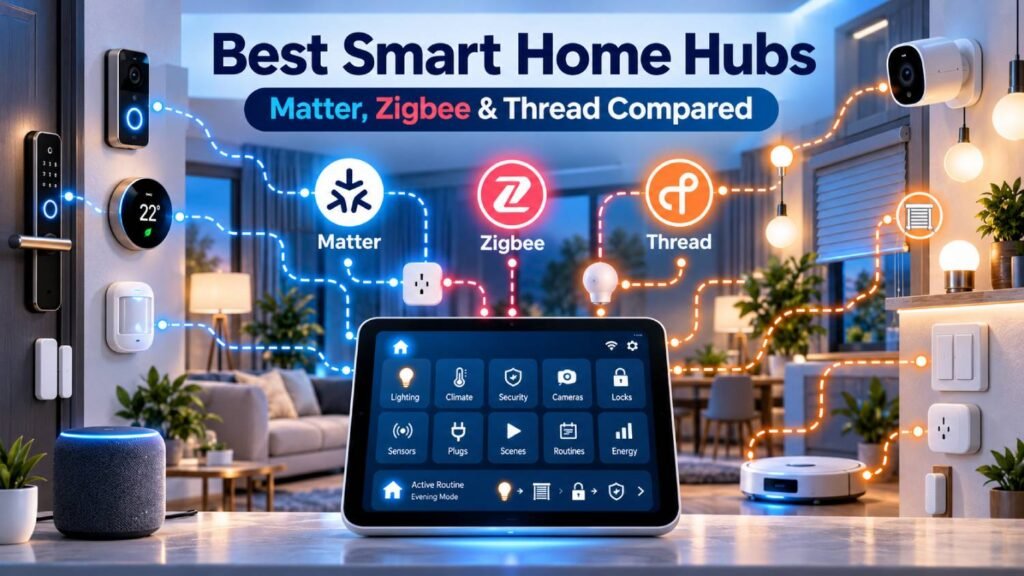
Choosing the best smart home hub can make managing connected devices easier, particularly when combining smart lighting, thermostats, sensors and security products from different manufacturers. However, not every hub supports the same wireless technologies or automation features.
Matter, Zigbee and Thread play different roles in smart home connectivity, and their compatibility can affect which devices work together. Some hubs offer built-in support for all three, while others require additional adapters or bridges.
This comparison examines six smart home hubs for UK households, focusing on compatibility, local control, ease of use and long-term flexibility.
Quick Answer
The Aqara Hub M3 is a strong choice for households using Aqara accessories, while the Amazon Echo Hub suits Alexa users. Apple HomePod mini works well within Apple Home, Aeotec Smart Home Hub accommodates mixed-brand devices, and Home Assistant Green or Homey Pro provide greater automation flexibility.
➥ Key Takeaways
- Matter improves interoperability between compatible smart home ecosystems, but does not replace Zigbee or Thread.
- Zigbee and Thread are separate mesh networking technologies with different infrastructure requirements.
- Not every Matter controller contains a Thread border router or Zigbee radio.
- Device compatibility, local automation and existing ecosystem support matter more than the number of protocols advertised.
Smart Home Hub Comparison Table
| Smart Home Hub | Best For | Matter Support | Zigbee Support | Thread Support |
|---|---|---|---|---|
| Aqara Hub M3 | Aqara households | Controller and bridge | Built-in | Border router |
| Amazon Echo Hub | Alexa users | Controller | Built-in | Border router |
| Apple HomePod mini | Apple Home | Controller | Separate bridge | Border router |
| Aeotec Smart Home Hub (V3) | Mixed-brand devices | Controller | Built-in | Border router |
| Home Assistant Green | Local automation | Software controller | USB adapter | Separate border router or configured radio |
| Homey Pro (2026) | Advanced automation | Controller | Built-in | Border router |
The table describes the hardware and software capabilities of the specified models, not universal compatibility with every accessory. Home Assistant Green requires Matter software configuration; Zigbee requires additional radio hardware, and Thread border routing requires compatible infrastructure.
How We Selected These Smart Home Hubs
These six products were selected through editorial research using manufacturer specifications, official support documentation and published connectivity information.
The comparison considers Matter, Zigbee and Thread support, device compatibility, ecosystem integration, local automation, installation requirements, security features and UK purchasing suitability.
Each hub addresses a different user requirement, from straightforward voice-assisted control to advanced multi-protocol automation. The order is based on practical use cases rather than benchmark scores or a claim of measured superiority. No hands-on product testing was conducted for this comparison.
6 Best Smart Home Hubs for Different Needs
1. Aqara Hub M3 — Best for Aqara Smart Home Devices
The Aqara Hub M3 combines Zigbee connectivity, Thread border routing and Matter controller functionality in a compact device. It is particularly useful for households already using Aqara sensors, switches and other accessories.
Its Matter bridge can expose supported Aqara Zigbee devices to other compatible smart home ecosystems. The hub also offers Power over Ethernet, infrared control and local automation capabilities.
The M3 can integrate selected third-party Matter devices into Aqara Home, although compatibility remains dependent on supported device categories and firmware. Its strongest value lies in managing Aqara equipment while extending interoperability beyond the brand.
Best for: Existing Aqara households
Protocols: Matter controller and bridge; built-in Zigbee; Thread border router
Price: Check current UK retailer pricing
Pros: Local automation support; Matter bridging for compatible Aqara devices
Cons: Third-party Matter support is selective; some Aqara features do not transfer across ecosystems
2. Amazon Echo Hub — Best for Alexa Smart Homes
The Amazon Echo Hub is an 8-inch touchscreen control panel for smart home devices connected to Alexa. Unlike a conventional speaker-based hub, it provides a central interface for controlling compatible lighting, cameras, plugs and routines.
Its integrated smart home capabilities include Zigbee, Matter controller functionality and a Thread border router, reducing the need for separate hardware for many supported accessories.
The interface is useful for households with multiple Alexa-compatible devices, particularly where family members prefer touchscreen controls over voice commands.
However, some features and integrations depend on Amazon services or internet connectivity. Local device control should not be confused with completely offline operation.
Best for: Alexa households wanting a central display
Protocols: Matter controller; built-in Zigbee; Thread border router
Price: Check current UK retailer pricing
Pros: Dedicated touchscreen interface; broad Alexa ecosystem integration
Cons: Amazon ecosystem dependence; limited appeal for households using other primary platforms
3. Apple HomePod mini — Best for Apple Home Users
The Apple HomePod mini is both a compact smart speaker and a controller for compatible Apple Home accessories. It supports Matter devices and incorporates Thread networking, allowing it to function as a Thread border router.
Once configured, it can support home automation and remote accessory control through Apple’s Home app.
It is an attractive option for households already using an iPhone, Apple TV or other Apple devices. Siri voice control and the familiar Home interface keep everyday operation relatively straightforward.
However, the HomePod mini does not contain a Zigbee coordinator. Traditional Zigbee accessories normally need an appropriate bridge before they can be controlled through Apple Home.
Best for: Apple Home and Siri users
Protocols: Matter controller; built-in Thread border router; Zigbee through a compatible bridge
Price: £129 from Apple UK at verification
Pros: Straightforward Apple Home integration; built-in Thread infrastructure
Cons: No native Zigbee radio; Apple-centric setup
4. Aeotec Smart Home Hub — Best for Mixed-Brand Smart Home Devices
The Aeotec Smart Home Hub works with Samsung SmartThings to manage compatible smart devices from different manufacturers.
The third-generation hub supports Zigbee, Z-Wave, Matter and Thread border routing, making it suitable for households with equipment using several connectivity standards.
SmartThings provides a shared interface for managing compatible lighting, switches, sensors and household devices. It also supports automation through its routines and locally executable device integrations.
A significant benefit is the ability to accommodate existing Zigbee and Z-Wave equipment alongside newer Matter devices. However, specific devices still require compatibility checks, and some cloud-connected functions depend on an internet connection.
Best for: Homes with devices from several manufacturers
Protocols: Matter controller; built-in Zigbee and Z-Wave; Thread border router
Price: Check current UK pricing for the V3 model
Pros: Multiple wireless protocols; SmartThings ecosystem integration
Cons: Some cloud-service dependence; functionality varies across connected brands
5. Home Assistant Green — Best for Privacy and Local Automation
Home Assistant Green is a dedicated device that runs the open-source Home Assistant platform. Its main advantage is highly customisable automation with an emphasis on local device management and control.
Home Assistant supports numerous integrations, allowing users to connect compatible products without committing to a single manufacturer’s ecosystem.
The Green hardware does not contain a built-in Zigbee or Thread radio. Zigbee connectivity requires additional hardware, such as Home Assistant Connect ZBT-2. Matter-over-Wi-Fi and Ethernet can be managed through the appropriate software configuration.
Matter-over-Thread devices require a Thread border router, which may be a separate device already on the network. Configuring Home Assistant’s own Thread border router involves additional hardware and setup, with some functionality still under development.
This flexibility makes Home Assistant Green particularly useful for technically confident users, although setup and maintenance demand more involvement than mainstream alternatives.
Best for: Privacy-conscious users and custom automation
Protocols: Matter via software; Zigbee through additional hardware; Thread through compatible border router infrastructure
Price: Check current UK reseller pricing; adapters cost extra
Pros: Extensive integration options; strong local-first automation capabilities
Cons: Extra radio hardware required; more technical configuration
6. Homey Pro — Best for Advanced Multi-Protocol Automation
Homey Pro (2026) is designed for households seeking extensive smart home connectivity without assembling several separate controller devices.
It integrates Matter, Zigbee, Thread border routing, Z-Wave, Bluetooth, infrared and other connectivity options. This makes it particularly relevant for homes with an established collection of smart accessories.
Homey’s Advanced Flow automation system allows users to create more detailed routines, while dashboards and device insights support centralised monitoring.
The hub also supports local execution for compatible apps and automations, although individual third-party integrations may still rely on external services.
Its major drawback is cost. Homey Pro is substantially more expensive than entry-level smart home controllers, so its additional functionality is most valuable to users who will actively use the broader protocol selection and automation tools.
Best for: Advanced automation and multiple wireless standards
Protocols: Matter controller; built-in Zigbee, Thread border router and Z-Wave
Price: £449 from Homey UK at verification
Pros: Broad built-in connectivity; advanced automation and dashboards
Cons: High initial cost; third-party integration capabilities vary
Matter vs Zigbee vs Thread — What’s the Difference?
Matter, Zigbee and Thread are frequently mentioned together, but they perform different functions within a smart home network.
| Technology | Main Purpose | Key Advantage | Important Limitation |
|---|---|---|---|
| Matter | Cross-brand interoperability | Common standard for supported devices | Not every device type or feature is supported |
| Zigbee | Low-power wireless mesh networking | Established ecosystem of sensors, lights and switches | Usually requires a coordinator or compatible bridge |
| Thread | Low-power IP-based mesh networking | Supports IP communication for compatible devices | Requires a border router to connect beyond the Thread network |
Matter is an application-layer standard that can operate over Wi-Fi, Ethernet or Thread. It does not use a dedicated Matter radio.
Thread provides the underlying wireless network for compatible devices, while Zigbee operates as a distinct wireless protocol.
A compatible Matter bridge can make supported Zigbee devices accessible to Matter controllers, but this does not convert the Zigbee devices into native Thread or Matter devices.
How to Choose the Best Smart Home Hub
The best smart home controller depends on your existing equipment, automation requirements and preferred ecosystem.
Check your current ecosystem. If most devices already work with Alexa or Apple Home, choosing a compatible hub can simplify installation. Mixed-brand households may benefit from SmartThings, Homey or Home Assistant.
Identify the required wireless protocols. Check whether your accessories use Matter-over-Wi-Fi, Matter-over-Thread, Zigbee or another standard. Verify native support rather than assuming a Matter logo guarantees compatibility.
Consider local control. Some devices and routines continue working without internet access, while others rely on cloud platforms. Check which specific automations remain operational offline.
Assess installation complexity. Apple Home and Alexa may suit beginners. Home Assistant offers deeper customisation but requires greater technical involvement.
Calculate the total cost. Include separate Zigbee coordinators, Thread border routers, bridges, optional subscriptions and future devices.
A hub supporting three protocols is not automatically a better purchase than one that reliably supports everything you already own.
Frequently Asked Questions
Is Matter better than Zigbee for a smart home?
Matter is not automatically better than Zigbee because the two technologies serve different purposes. Matter improves interoperability between compatible ecosystems, while Zigbee provides low-power wireless networking. The better choice depends on the devices you own and whether your hub supports them.
Do I need a Thread border router for Matter devices?
Only Matter-over-Thread devices require a Thread border router to communicate with controllers outside their Thread network. Matter-over-Wi-Fi and Matter-over-Ethernet devices do not require one. Some smart home hubs already contain the necessary Thread border router hardware.
Can one smart home hub support Matter, Zigbee and Thread?
Yes. Products including Aqara Hub M3, Aeotec Smart Home Hub V3 and Homey Pro support all three through appropriate built-in hardware and software. However, compatible device categories, third-party integrations and individual features may still differ.
Will smart home devices work without an internet connection?
Some smart home devices and locally configured automations can operate without internet access. However, remote access, cloud integrations, voice assistants and certain routines may stop working. Offline functionality depends on the hub, connected devices and the way automations are configured.
Final Thoughts
There is no single smart home hub that suits every household.
Aqara Hub M3 is particularly relevant for Aqara users, Amazon Echo Hub serves Alexa households, and HomePod mini integrates naturally with Apple Home. Aeotec Smart Home Hub accommodates a broader mix of wireless devices, while Home Assistant Green offers extensive customisation and Homey Pro brings multiple protocols together in one system.
The best choice balances compatibility, ease of use, automation flexibility and overall cost.
Before purchasing, check the exact model, supported device categories, required accessories and current firmware compatibility.
Editorial Disclosure
Research basis: This comparison uses publicly available manufacturer specifications, product documentation and official support resources. It does not represent independent hands-on testing or performance benchmarking.
Commercial disclosure: Any affiliate links, sponsorships or commercial relationships must be accurately disclosed by the publisher before publication.
Information accuracy: Product specifications, prices, firmware capabilities and UK availability may change. Readers should verify current compatibility and purchasing information directly with manufacturers or authorised retailers.
Last reviewed: 8 October 2026.