
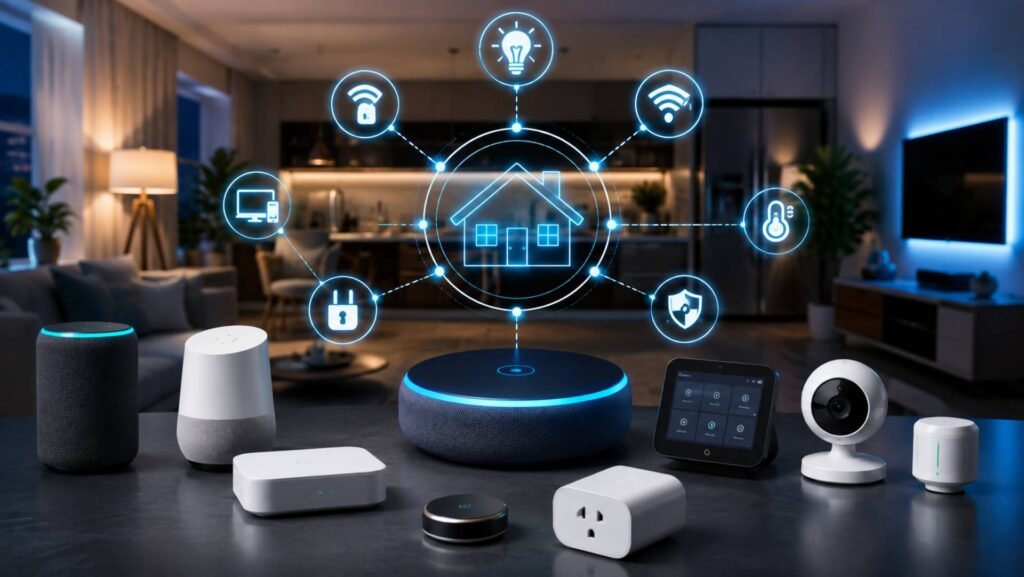
A good smart home should not require five apps, three bridges, and a troubleshooting session every time you want the lights to turn off. The best smart home hubs reduce that fragmentation by giving compatible lights, locks, sensors, thermostats, cameras, switches, and other devices a central place to communicate and automate.
In 2026, however, choosing a hub is more complicated than simply asking which model supports the most devices. Matter has improved cross-platform interoperability, Thread is becoming increasingly important for low-power Matter products, and established protocols such as Zigbee and Z-Wave remain widely used. Meanwhile, Apple Home, Amazon Alexa, Google Home, Samsung SmartThings, Hubitat, and Home Assistant approach automation and local processing differently.
Our editorial assessment finds Hubitat Elevation C-8 Pro the strongest overall choice for users who prioritize local automation and broad protocol support. Aeotec Smart Home Hub 2 is easier for mainstream SmartThings households, while Home Assistant Green offers exceptional flexibility for people willing to invest more time—and potentially additional radio hardware—into their setup.
The right choice ultimately depends on the devices you already own.
Key Takeaways
- Best overall: Hubitat Elevation C-8 Pro for powerful local automation, Zigbee, Z-Wave Long Range, Matter, Wi-Fi, Ethernet, and extensive customization.
- Best beginner-friendly dedicated hub: Aeotec Smart Home Hub 2, particularly for SmartThings users who want Matter, Thread, and Zigbee without an enthusiast-level learning curve.
- Best for advanced local automation: Home Assistant Green, provided you are comfortable adding radios and configuring integrations.
- Best ecosystem-specific options: Amazon Echo Hub for Alexa, Google Home Speaker for Google Home, and Apple HomePod mini for Apple Home.
- Matter does not eliminate the need to check radios. A Matter controller is not automatically a Thread Border Router, Zigbee coordinator, or Z-Wave controller.
- Z-Wave users need to be especially careful: the current U.S. Aeotec Smart Home Hub 2 does not include Z-Wave, while Hubitat C-8 Pro does.
Quick Answer: Which Smart Home Hub Should You Buy?
Choose Hubitat Elevation C-8 Pro if you want powerful automations, strong local processing, Zigbee and Z-Wave support, and less dependence on cloud services.
Choose Aeotec Smart Home Hub 2 if you want a simpler SmartThings-centered system with Matter, Thread, Zigbee, Ethernet, Wi-Fi, and substantial local execution.
Choose Home Assistant Green if customization, local ownership, privacy, and cross-brand integration matter more than plug-and-play simplicity.
Choose Amazon Echo Hub if Alexa is already the center of your household and you want a dedicated touchscreen controller.
Choose Google Home Speaker if you want an inexpensive Matter and Thread hub built around Google Home and Gemini.
Choose Apple HomePod mini if your household primarily uses iPhones, Apple Home, Siri, and Matter-over-Thread accessories.
Editorial Disclosure
Product specifications, protocol support, software features, subscription terms, pricing and availability can change after publication. Compatibility can also differ by device model, region, firmware version and smart-home ecosystem. Readers should confirm critical compatibility and current U.S. pricing with the manufacturer before purchasing.
Matter, Thread, Zigbee, Z-Wave, Alexa, Google Home, Apple Home, SmartThings, Home Assistant and all other product or company names belong to their respective owners.
This article provides editorial research and comparison information and does not claim laboratory or first-hand product testing.
At-a-Glance Smart Home Hub Comparison
| Product | Best For | Matter | Thread Border Router | Zigbee | Z-Wave | Local Control | Main Ecosystem | Approx. U.S. Price |
|---|---|---|---|---|---|---|---|---|
| Hubitat Elevation C-8 Pro | Best overall/local automation | Yes, controller | No on standard model | Yes | Yes, 800-series + LR | Extensive | Hubitat; Alexa, Google and Apple integrations | $188.95 |
| Aeotec Smart Home Hub 2 | Easiest multiprotocol SmartThings hub | Yes | Yes | Yes, Zigbee 3.0 | No on U.S. Hub 2 | Most supported automations can run locally | SmartThings, Alexa, Google | $119.99 |
| Home Assistant Green | Advanced automation and local ownership | Yes | No built-in; expandable | Add-on required | Add-on required | Extensive | Home Assistant | $199 |
| Amazon Echo Hub | Alexa households | Yes | Yes, Thread 1.3 | Yes | No | Partial/select devices | Alexa | $179.99 |
| Google Home Speaker | Google Home households | Yes | Yes, Thread 1.3 | No | No | Partial | Google Home/Gemini | $99.99 |
| Apple HomePod mini | Apple Home households | Yes | Yes | No | No | Strong within Apple Home | Apple Home/Siri | $129 |
Pricing note: Prices were checked on August 25, 2026. Promotions and retailer availability can change.
How We Chose the Best Smart Home Hubs
This guide is based on documented specifications, current manufacturer information, standards documentation, platform support pages, and current U.S. pricing. We did not claim hands-on laboratory testing because no such testing was performed for this article.
Products were assessed using the following editorial weighting:
| Criterion | Weight |
| Device and ecosystem compatibility | 20% |
| Matter, Thread and protocol support | 15% |
| Automation capabilities | 15% |
| Reliability and local control | 15% |
| Ease of use | 10% |
| Privacy and security | 10% |
| Setup and management | 5% |
| Long-term ecosystem value | 5% |
| Price/value | 5% |
We also considered whether each product has a clearly defined reason to exist in a 2026 smart home. A speaker that happens to control a few devices was not automatically favored over a dedicated automation controller.
Protocol terminology was checked carefully. Matter is an interoperability standard, while Thread is an IP-based, low-power mesh networking technology. A Thread Border Router connects a Thread network with other IP networks; Zigbee and Z-Wave require their own appropriate coordinators/controllers.
Matter itself is still evolving. The Connectivity Standards Alliance released Matter 1.6 on June 17, 2026, but the Alliance explicitly notes that manufacturers and ecosystems adopt new specification features according to their own schedules. A product supporting Matter should therefore not be assumed to support every Matter 1.6 feature today.
Editorial transparency: No sponsored brand, brand URL, or commercial CTA was supplied for this draft, so none has been invented or allowed to influence the rankings.
1. Hubitat Elevation C-8 Pro — Best Overall Smart Home Hub
Quick Product Snapshot
Best for: Local automation, mixed Zigbee/Z-Wave homes and enthusiasts
Approximate price: $188.95
Protocols: Zigbee 3.0, Z-Wave 800-series/LR, Matter, Bluetooth, Wi-Fi, Ethernet
Matter: Matter controller
Thread: Separate Thread Border Router required on the standard model
Local control: Extensive
Setup difficulty: 3/5 — Moderate
Primary ecosystem: Hubitat
Why It Stands Out
The standard Hubitat Elevation C-8 Pro offers one of the strongest combinations of direct protocol support and local automation in this comparison. Current specifications include Zigbee 3.0, an 800-series Z-Wave radio with Z-Wave Long Range, Matter controller functionality, Bluetooth support, Wi-Fi, Ethernet, external antennas, and local processing. Hubitat currently lists compatibility with more than 1,000 devices across 100-plus brands.
Its biggest advantage is not simply the radio list. Automations are designed to run on the hub rather than relying primarily on an external cloud, helping routines continue during many internet disruptions.
Compatibility, Setup and Everyday Use
Hubitat includes automation tools ranging from basic rules to considerably more detailed conditional logic. Built-in integrations include Amazon Echo, Google Home and HomeKit functionality. The newer C-8 Pro can also pair supported HomeKit accessories directly through Hubitat’s HomeKit Controller integration, although compatibility is not universal.
The trade-off is complexity. Hubitat is more approachable than building a home-automation server from scratch, but it requires more learning than Alexa, Google Home or Apple Home.
There is also an important 2026 distinction: the normal C-8 Pro is not a Thread Border Router. On August 20, 2026, Hubitat announced a limited Thread Special Edition that substitutes a Thread radio for the normal Zigbee radio. Buyers should therefore check exactly which C-8 Pro version they are ordering.
Privacy and Local Control
Hubitat’s core proposition is local processing. Optional paid services exist for functions such as Remote Admin, cloud backup and extended hub protection, but Hubitat has stated that these services are not required for ordinary hub use.
Pros
- Native Zigbee and Z-Wave 800-series/Long Range support
- Powerful local automation
- Matter controller support
- Ethernet and Wi-Fi
- Broad customization and integrations
Cons
- Standard C-8 Pro lacks an integrated Thread Border Router
- More complicated than mainstream voice-assistant ecosystems
- Some remote administration and backup conveniences are optional paid services
Who Should Buy It?
Buy the C-8 Pro if you already own a mixture of Zigbee and Z-Wave devices or want sophisticated automation without making cloud services the center of your home.
Who Should Skip It?
Choose Aeotec Smart Home Hub 2 instead if you prioritize an easier SmartThings experience, or Home Assistant if maximum open-platform customization matters more.
Editor’s Verdict
Hubitat C-8 Pro is our best overall choice because it balances broad radio support, sophisticated automations and local execution better than the other hubs reviewed. Its key compromise is Thread: the standard model requires another Thread Border Router, while the limited Thread edition gives up the standard Zigbee radio.
2. Aeotec Smart Home Hub 2 — Best for SmartThings and Beginners
Quick Product Snapshot
Best for: SmartThings households
Approximate price: $119.99
Protocols: Matter, Thread, Zigbee 3.0, Wi-Fi, Ethernet, Bluetooth for onboarding/diagnostics
Z-Wave: No on the current U.S. Hub 2
Local control: Substantial, not completely cloud-independent
Setup difficulty: 2/5 — Easy
Primary ecosystem: Samsung SmartThings
Why It Stands Out
The Aeotec Smart Home Hub 2 is arguably the most approachable dedicated multiprotocol controller in this group. Aeotec lists Matter, Thread and Zigbee 3.0, plus Ethernet, Wi-Fi and Bluetooth-assisted onboarding. It is built around Samsung SmartThings and works with Alexa, Google Home and Bixby voice control.
SmartThings Edge drivers allow supported hub-connected devices and automations to execute locally, which can improve responsiveness and reduce reliance on cloud round trips.
Compatibility and the Z-Wave Catch
One specification deserves particular attention. Older Aeotec/SmartThings hubs became popular partly because they supported both Zigbee and Z-Wave. The U.S. Smart Home Hub 2 does not include Z-Wave. Aeotec’s official Americas store explicitly labels the Hub 2 V4 as “No Z-Wave,” while continuing to sell the earlier Smart Home Hub V3 for users who need it.
That distinction prevents Hub 2 from replacing Hubitat for a Z-Wave-heavy household.
Setup, Privacy and Everyday Use
The SmartThings app is considerably friendlier for newcomers than advanced platforms such as Hubitat or Home Assistant. Aeotec states that most supported automations and controls can execute offline, but SmartThings remains a connected ecosystem rather than a fully self-contained local platform.
Pros
- Matter, Thread and Zigbee in one mainstream hub
- SmartThings Edge supports substantial local execution
- Ethernet and Wi-Fi
- Easy mobile-app management
- Competitive $119.99 current price
Cons
- No Z-Wave on the U.S. Hub 2
- Less automation freedom than Hubitat or Home Assistant
- Some ecosystem functions remain cloud-dependent
Who Should Buy It?
It is a strong choice for someone beginning a SmartThings system around Matter, Thread and Zigbee.
Who Should Skip It?
Skip it if you already own significant numbers of Z-Wave locks, switches or sensors.
Editor’s Verdict
Aeotec Smart Home Hub 2 is the easiest dedicated hub we recommend for mainstream users. Its combination of SmartThings, Matter, Thread, Zigbee and local Edge execution is compelling, but removing Z-Wave from the U.S. model is a meaningful limitation.
3. Home Assistant Green — Best for Advanced Automation and Local Ownership
Quick Product Snapshot
Best for: Customization, privacy and large cross-brand systems
Approximate price: $199
Built-in radio protocols: None for Zigbee, Thread or Z-Wave
Matter: Yes over Wi-Fi/Ethernet with the Matter integration
Thread: Requires compatible Thread hardware/Border Router
Local control: Extensive
Setup difficulty: 4/5 — Advanced
Primary ecosystem: Home Assistant
Why It Stands Out
Home Assistant Green takes a different approach. Instead of shipping with every smart-home radio, it provides dedicated hardware for running Home Assistant OS and then lets users add integrations or USB radios as needed.
Current hardware includes a 1.8GHz quad-core processor, 4GB of RAM, 32GB eMMC storage, two USB 2.0 ports and Gigabit Ethernet. Home Assistant states that home data can remain local and the platform remains accessible when the internet is unavailable.
Expansion Is Both Its Strength and Weakness
Green’s current U.S. MSRP is $199, substantially higher than its original launch price.
Direct radios cost extra. Home Assistant Connect ZBT-2 is $49 and can be dedicated to either Zigbee or Thread, but not both simultaneously. Connect ZWA-2 costs $69 and provides an 800-series Z-Wave interface with Z-Wave Long Range support.
Home Assistant documentation supports configuring compatible radios as Thread Border Routers, although its Green product page still carries a “Thread support is currently under development” note for ZBT-2. Because the documentation is actively changing, anyone purchasing specifically for Thread should verify the current software status immediately before buying.
Privacy and Subscriptions
Home Assistant itself is free and open source. Home Assistant Cloud is optional and adds simplified remote access plus integrations such as Alexa and Google Assistant; the core platform continues to work without that subscription.
Pros
- Exceptional automation flexibility
- Strong local-data philosophy
- Huge integration ecosystem
- Expandable Zigbee, Thread and Z-Wave options
- No required software subscription
Cons
- No built-in Zigbee, Thread or Z-Wave radio
- $199 base price makes a full radio setup expensive
- Greater learning curve
- ZBT-2 must be dedicated to Zigbee or Thread rather than both
Who Should Buy It?
Choose Green if you want to build a smart home around Home Assistant rather than around one commercial ecosystem.
Who Should Skip It?
Skip it if you want a box that pairs directly with Zigbee and Z-Wave products immediately after unboxing.
Editor’s Verdict
Home Assistant Green is the strongest platform here for people who value control and extensibility more than convenience. Its software is extremely capable, but Green is no longer the inexpensive route to a multiprotocol system once optional radios are included.
4. Amazon Echo Hub — Best Smart Home Hub for Alexa
Quick Product Snapshot
Best for: Alexa-centered homes and wall-mounted control
Approximate price: $179.99
Protocols: Matter, Thread, Zigbee, Bluetooth, Amazon Sidewalk, Wi-Fi
Matter: Yes
Thread: Thread 1.3 Border Router
Local control: Partial/select devices
Setup difficulty: 1/5 — Very easy
Primary ecosystem: Amazon Alexa
Why It Stands Out
The Amazon Echo Hub is a purpose-built eight-inch smart-home control panel rather than simply a smart speaker that happens to include hub functionality. It can display lights, cameras, locks, thermostats and Alexa Routines from a customizable dashboard.
Amazon documents support for Zigbee, Matter, Thread, Bluetooth and Sidewalk, with Ethernet possible through a compatible Power-over-Ethernet adapter.
More importantly, Amazon’s current developer documentation lists Echo Hub as a Matter controller supporting Matter over Wi-Fi and Matter over Thread and as a Thread 1.3 Border Router. Alexa’s Matter implementation currently uses a Matter 1.5 SDK subset.
Local Control and Everyday Use
Alexa can communicate locally with some Matter and supported smart-home devices, reducing latency and allowing certain functions to survive internet interruptions. That should not be interpreted as fully local operation: Alexa’s wider assistant, account and cloud ecosystem still plays an important role.
Pros
- Dedicated touchscreen control center
- Zigbee, Matter and Thread support
- Thread 1.3 Border Router
- Extremely easy for existing Alexa households
- Wall or counter placement
Cons
- No native Z-Wave
- Less sophisticated automation than Hubitat or Home Assistant
- Greater dependence on Amazon’s ecosystem and services
Who Should Buy It?
Alexa users who want a visible household control panel rather than another app will receive the most value.
Who Should Skip It?
Power users seeking deep local automation should choose Hubitat or Home Assistant instead.
Editor’s Verdict
Echo Hub is the best Alexa smart home hub in this selection because the touchscreen makes device control central to its purpose rather than a secondary feature.
5. Google Home Speaker — Best Smart Home Hub for Google Home
Quick Product Snapshot
Best for: Google Home and Gemini users
Approximate price: $99.99
Protocols: Matter, Thread, Wi-Fi 6, Bluetooth 5.4
Matter: Works as a Google Home Matter hub
Thread: Thread 1.3 Border Router
Zigbee/Z-Wave: No
Local control: Partial
Setup difficulty: 1/5 — Very easy
Primary ecosystem: Google Home/Gemini
Why It Stands Out
Released in 2026, the Google Home Speaker provides one of the lowest-cost routes into a mainstream Matter-and-Thread ecosystem. Google lists it at $99.99 with Wi-Fi 6, Bluetooth 5.4, Matter hub functionality and a Thread 1.3 Border Router.
That combination makes it particularly attractive for someone buying new Matter-over-Thread lights, sensors or other compatible devices without an existing Thread Border Router.
The Subscription Question
Basic Google Home functionality does not require turning the speaker into a $10-per-month product. However, Google currently bundles a six-month trial of Google Home Premium and places features including Gemini Live and natural-language complex automation creation behind the Standard subscription, currently listed at $10 per month or $100 per year after applicable trials.
Pros
- Low $99.99 hardware price
- Matter hub and Thread 1.3 Border Router
- Wi-Fi 6
- Straightforward Google Home setup
- Hardware microphone mute control
Cons
- No Zigbee
- No Z-Wave
- Advanced Gemini features may require Google Home Premium
- Less suitable for sophisticated local automation
Who Should Buy It?
It is the logical choice for Google Home households building primarily around Wi-Fi, Matter and Thread.
Who Should Skip It?
Skip it if you need direct Zigbee or Z-Wave pairing.
Editor’s Verdict
The Google Home Speaker is a strong inexpensive hub for a modern Matter/Thread household, but it is not a direct replacement for a multiprotocol automation controller.
6. Apple HomePod mini — Best Smart Home Hub for Apple Home
Quick Product Snapshot
Best for: iPhone and Apple Home households
Approximate price: $129
Protocols: Matter, Thread, Wi-Fi/Bluetooth-related Apple connectivity
Matter: Apple Home hub/controller functionality
Thread: Yes, Thread-enabled home hub
Zigbee/Z-Wave: No direct support
Local control: Strong within Apple Home
Setup difficulty: 1/5 — Very easy for Apple users
Primary ecosystem: Apple Home/Siri
Why It Stands Out
For an Apple-centered home, HomePod mini remains a simple way to provide a persistent Apple Home hub and Thread infrastructure.
Apple states that HomePod mini can serve as a home hub for remote control and automation and identifies it as a Thread-enabled home hub for supported Thread accessories.
Apple’s U.S. store currently lists HomePod mini at $129, so older articles quoting its original $99 price are no longer current as of this review.
Privacy and Local Control
Apple says Home app data is stored in a way that Apple cannot read, accessory communication is end-to-end encrypted, and Home accessories are controlled by Apple devices rather than requiring every command to pass through Apple’s cloud. Third-party devices and services can, of course, have their own privacy practices.
Pros
- Excellent Apple Home integration
- Built-in Thread capability
- Matter support
- Straightforward setup for iPhone households
- Strong documented privacy architecture
Cons
- No Zigbee
- No Z-Wave
- No Ethernet
- Limited appeal outside Apple households
- Current $129 price is higher than its historical $99 level
Who Should Buy It?
Apple users who want Matter/Thread support and Home automations with minimal setup.
Who Should Skip It?
Alexa-, Google- or mixed-protocol households can obtain much greater flexibility elsewhere.
Editor’s Verdict
HomePod mini is not the most flexible hub overall, but it does not need to be. Within an Apple Home household, its simple setup, Thread support and privacy architecture make it the most natural ecosystem-specific choice.
Smart Home Hub Buying Guide
Do You Still Need a Smart Home Hub in 2026?
Sometimes yes—but not necessarily a dedicated box.
Matter has reduced the need for proprietary bridges in some situations because compatible devices can be commissioned into multiple major smart-home ecosystems. It has not turned every smart speaker, router and protocol into the same thing.
A voice assistant interprets requests such as “turn off the kitchen lights.”
A Matter controller commissions and controls Matter devices.
A Thread Border Router provides IP connectivity between a Thread network and the rest of your home network.
A dedicated automation hub can add local rules, protocol radios, dashboards, integrations and more sophisticated conditional behavior.
A device can perform several of these roles, but it does not automatically perform all of them.
You may not need a dedicated hub if every device you own works reliably through a single Wi-Fi/Matter ecosystem and your automations are simple. A dedicated hub becomes much more valuable when you want Zigbee or Z-Wave devices, complex local routines, better resilience during internet outages or greater independence from a single cloud provider.
Matter vs. Thread vs. Zigbee vs. Z-Wave
| Technology | What It Does | Hub/Controller Requirement | Main Strength | Important Limitation |
| Matter | Application-layer interoperability standard for compatible smart-home devices | Requires a Matter controller; it may be built into a speaker, hub, TV device or other hardware | Cross-ecosystem interoperability | “Matter support” does not guarantee Thread, Zigbee or Z-Wave radios |
| Thread | Low-power, IPv6-based mesh networking | Thread can form a mesh itself, but consumer Matter-over-Thread networks generally use a Thread Border Router to reach the home IP network | Low-power IP mesh for sensors and other devices | Thread is a network technology, not the same thing as Matter |
| Zigbee | Low-power mesh networking and application stack | Requires an appropriate Zigbee coordinator/hub | Large established ecosystem and low-power devices | Direct compatibility still depends on hub/device implementation |
| Z-Wave | Sub-GHz smart-home wireless technology | Requires a Z-Wave controller | Avoids the crowded 2.4GHz Wi-Fi spectrum; strong installed base | Fewer mainstream voice speakers include Z-Wave radios |
Zigbee uses IEEE 802.15.4 and commonly operates at 2.4GHz, with a self-healing mesh designed for low-power devices. Z-Wave operates at 908.42MHz in the United States and Canada, separating it from ordinary Wi-Fi frequencies.
Local Control vs. Cloud Control
Local control means at least some decisions and device commands can execute inside your home rather than requiring a request to travel to an external server first.
Its advantages can include faster response, continued operation during some internet outages and reduced exposure of routine home-automation activity to third-party cloud services.
Cloud systems have advantages too. They can make remote access, account synchronization, voice assistants and integration with online services much easier.
The important question is therefore not “local or cloud?” but which functions are local and which stop working when the internet disappears?
Hubitat and Home Assistant place local operation near the center of their architecture. SmartThings uses local Edge execution for many hub-connected integrations. Amazon, Google and Apple also support forms of local device communication, but their broader assistant ecosystems depend more heavily on online services.
Which Smart Home Ecosystem Should You Choose?
Alexa Households
Choose Amazon Echo Hub if Alexa is already your primary voice platform. Its Zigbee radio gives it an advantage over Google and Apple for direct legacy-device integration.
Google Home Households
Choose Google Home Speaker when Wi-Fi, Matter and Thread form the foundation of your system. Its $99.99 price also makes it one of the least expensive current Thread Border Routers in this comparison.
Apple Home Households
Choose HomePod mini if your family uses iPhones and Apple Home. Apple Home’s strong privacy design and Thread support are important benefits, but direct Zigbee and Z-Wave support are absent.
Samsung SmartThings Households
Choose Aeotec Smart Home Hub 2 if Matter, Thread and Zigbee cover your requirements. If you already own Z-Wave equipment, check alternatives carefully because the U.S. Hub 2 no longer provides a Z-Wave radio.
Home Assistant and Advanced Automation Households
Choose Home Assistant Green when integration breadth and customization are the priorities. If you want strong native Zigbee and Z-Wave capabilities with less hardware expansion, Hubitat C-8 Pro may actually be the simpler solution.
What to Look for When Buying a Smart Home Hub
Protocol compatibility
Inventory your existing devices before purchasing. A hub with excellent Matter support is still the wrong purchase if most of your current sensors use Z-Wave.
Matter controller support
Confirm that the product functions as a controller rather than merely being a Matter-compatible accessory.
Thread Border Router capability
This matters for Matter-over-Thread devices. Never infer Thread hardware from the presence of a Matter logo.
Zigbee and Z-Wave
Older protocols remain highly relevant. Replacing dozens of working Zigbee or Z-Wave devices just to adopt a newer ecosystem rarely makes financial sense.
Local automation
Ask what happens if the internet connection goes down. Basic scheduled lighting is a good example of an automation many people reasonably expect to continue.
Automation sophistication
Simple routines are adequate for many households. Conditional rules involving presence, multiple sensors, modes, time ranges and state tracking favor platforms such as Hubitat and Home Assistant.
Ethernet versus Wi-Fi
Ethernet can provide a predictable network connection for a permanently installed central hub. Wi-Fi offers more placement flexibility.
Privacy
Review both hub-provider policies and the practices of any cloud-connected accessory manufacturers. A locally oriented hub cannot make a third-party cloud camera local by itself.
Subscription requirements
Separate required subscriptions from optional ones. Home Assistant Cloud and Hubitat’s additional remote/backup services are optional, while some advanced Google Home/Gemini functions require Google Home Premium.
Long-term support
Matter is still moving quickly. Matter 1.6 arrived only in June 2026, so software maintenance can be just as important as the radios included on launch day.
Which Smart Home Hub Is Best for You?
| If You Want… | Consider… | Why |
| Simplest dedicated multiprotocol setup | Aeotec Smart Home Hub 2 | Matter, Thread and Zigbee inside an approachable SmartThings system |
| Maximum local control with built-in radios | Hubitat C-8 Pro | Local automation plus native Zigbee and Z-Wave |
| Maximum customization | Home Assistant Green | Extremely broad integration and automation platform |
| Best Alexa integration | Amazon Echo Hub | Alexa-first touchscreen with Zigbee, Matter and Thread |
| Best Google Home integration | Google Home Speaker | Matter hub and Thread Border Router for $99.99 |
| Best Apple integration | HomePod mini | Native Apple Home hub with Thread |
| Strong Zigbee + Z-Wave support | Hubitat C-8 Pro | Both radios are built into the standard model |
| Matter-over-Thread without extra hardware | Echo Hub, Google Home Speaker, HomePod mini or Aeotec Hub 2 | Integrated Thread capability |
| Privacy-focused DIY platform | Home Assistant Green | Local data model with optional cloud services |
Frequently Asked Questions
What is the best smart home hub in 2026?
Hubitat Elevation C-8 Pro is our strongest overall recommendation for households that value local automation and broad protocol support because the standard model combines Zigbee 3.0, Z-Wave 800-series/Long Range, Matter controller support, Wi-Fi and Ethernet. It does not include a Thread Border Router on the standard version, so Matter-over-Thread users may need additional Thread infrastructure.
Do I need a smart home hub if my devices support Matter?
Not necessarily. You need a compatible Matter controller, but that controller can be built into another product such as a smart speaker or smart-home control panel. Matter-over-Thread devices additionally need access to a compatible Thread Border Router. Zigbee and Z-Wave devices still require appropriate controllers.
Is Alexa a smart home hub?
Alexa is primarily Amazon’s smart-home and voice-assistant platform, but selected Echo hardware includes hub functionality. Echo Hub, for example, supports Matter, Zigbee and Thread and contains a Thread 1.3 Border Router. Not every Alexa device has the same radios, so check the specific Echo model.
Is Google Home a smart home hub?
Google Home is the ecosystem, while specific Google hardware can perform hub functions. The 2026 Google Home Speaker is officially listed as a hub for Matter with Google Home and includes a Thread 1.3 Border Router. It does not provide native Zigbee or Z-Wave radios.
Does Apple Home require a hub?
Apple Home can control supported accessories from Apple devices, but a persistent home hub enables important capabilities including remote access and automations. Apple identifies HomePod, HomePod mini and compatible Apple TV models as home hubs. Thread accessories require compatible Thread infrastructure.
Is Home Assistant better than SmartThings?
Home Assistant offers greater customization and a stronger emphasis on local ownership, but it also requires more configuration. SmartThings is generally easier for mainstream users. Home Assistant Green additionally needs separate hardware for direct Zigbee, Thread or Z-Wave networks, while Aeotec Smart Home Hub 2 includes Zigbee and Thread.
What is the difference between Matter and Thread?
Matter defines how compatible smart-home devices communicate at the application level. Thread provides an IPv6-based low-power mesh network over which Matter can operate. A Matter device can use Thread, Wi-Fi or Ethernet depending on its design. Thread and Matter therefore complement each other but are not interchangeable.
Do smart home hubs work without the internet?
Some do substantially more than others. Hubitat and Home Assistant emphasize local execution. SmartThings Edge can run many supported hub-connected devices and automations locally. Matter can also support local communication. Cloud voice assistants, remote access and online integrations may still stop working when internet service is unavailable.
Which smart home hub supports both Zigbee and Z-Wave?
Among the products in this comparison, the standard Hubitat Elevation C-8 Pro directly supports both Zigbee 3.0 and Z-Wave 800-series/Z-Wave Long Range. The current U.S. Aeotec Smart Home Hub 2 supports Zigbee but does not include Z-Wave.
Can one smart home hub control everything?
No hub can safely be assumed to control every device. Compatibility depends on protocol, device type, drivers, manufacturer APIs and ecosystem restrictions. Matter improves interoperability, but proprietary features can still differ between platforms. Verify high-priority devices individually before choosing a hub.
Final Recommendation
There is no universally superior smart home hub because the devices already installed in your home matter more than a generic ranking.
For the widest range of serious home-automation scenarios, Hubitat Elevation C-8 Pro is our overall recommendation. Its combination of Zigbee, Z-Wave 800-series/Long Range, Matter, local processing and sophisticated automation provides unusually broad capability without requiring a self-built server.
It is not the automatic winner for everyone. The standard C-8 Pro’s lack of an integrated Thread Border Router is a genuine limitation.
Aeotec Smart Home Hub 2 is our preferred beginner-friendly dedicated alternative when Z-Wave is not required. Home Assistant Green is the better platform for people who want maximum customization and are comfortable adding the required radios.
For consumers already committed to a major voice ecosystem, there is little reason to fight it: use Echo Hub for Alexa, Google Home Speaker for Google Home, and HomePod mini for Apple Home unless your device inventory creates a specific compatibility problem.
Before buying anything, make a list of your current devices and mark each one Wi-Fi, Matter, Thread, Zigbee, Z-Wave or proprietary. That simple audit will often identify the correct hub faster than any overall ranking.
Last Checked: August 25, 2026
Review Due: November 25, 2026