
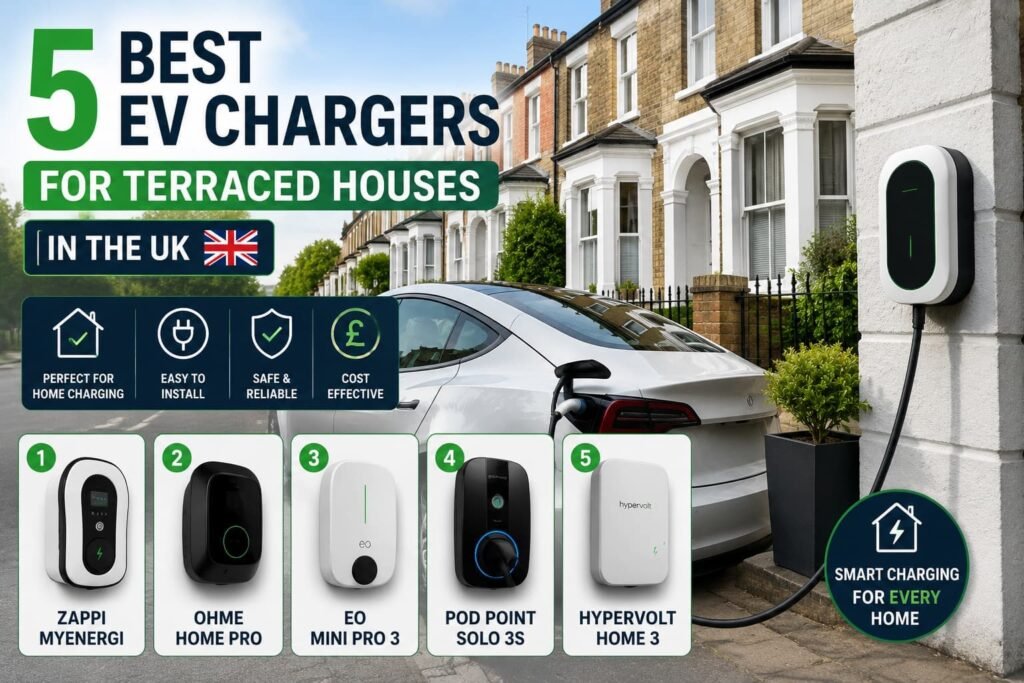
An electric car and a terraced house are not incompatible. The difficulty begins when the front door, pavement and parked car are separated by land you do not own.
If you have a driveway or private parking bay, choosing a home charger is comparatively straightforward. If your EV sits on a public road, the wallbox is only one part of the system. You may also need council approval, planning consent and an approved cross-pavement cable channel — and even then, nobody is obliged to leave the space outside your property free.
This guide therefore ranks chargers according to how well they fit the realities of British terraced streets rather than simply declaring the fastest unit the winner.
Key Takeaways
- A home charger does not solve the pavement problem. If your EV is parked on the street, you must first confirm whether you have a safe and authorised route from the property to the vehicle.
- Council rules vary across the UK. Pavement cable gullies, channels and temporary cable covers are not universally permitted, so check with your local council or highways authority before installation.
- Reliable parking matters as much as cable length. Even a 10-metre charging cable may be impractical if you cannot regularly park outside or near your home.
- Hypervolt Home 3 Pro is the strongest all-round option in this comparison because of its longer cable choices, smart-tariff support, solar compatibility and strong owner feedback.
- Ohme Home Pro is particularly suitable for smart-tariff users, while the myenergi zappi is the strongest choice for households prioritising solar charging.
- Compact and tidy installations matter on narrow terraces. Easee One suits limited wall space, while Andersen A3 stands out for concealed cable storage.
- Check the complete installed cost, not just the charger price. Electrical upgrades, longer cable runs, DNO work, planning requirements and pavement-channel costs can materially increase the final bill.
- Public charging may be the better solution for some terraced homes. If you cannot reliably park near your property, lamp-post, kerbside, workplace or public charging may be more practical than installing a private wallbox.
Quick Verdict
Best Overall: Hypervolt Home 3 Pro
Best for Smart Tariffs: Ohme Home Pro
Best for Solar Integration: myenergi zappi
Best for Cable Management: Andersen A3
Best Compact Charger: Easee One
Brief Research Summary
Hypervolt takes first place because its combination of a 10-metre optional tethered cable, smart-tariff integrations, solar support, load management and strong independent owner feedback gives it unusually broad usefulness for awkward installations.
Ohme scores particularly well for tariff automation. zappi remains the strongest specialist proposition for homes with solar generation. Andersen’s A3 has the neatest integrated cable-storage approach. Easee One is particularly attractive where wall space and visual clutter matter.
Wallbox, Pod and other established alternatives were considered. They were not excluded because they are unsuitable products; the five selected chargers simply offered more distinct advantages for the specific terraced-house use cases used in this ranking.
Comparison Table
| Rank | EV Charger | Best For | Current Hardware Price* | Max AC Rate | Cable | Smart Tariffs | Solar | Warranty | Terraced-House Suitability |
|---|---|---|---|---|---|---|---|---|---|
| 1 | Hypervolt Home 3 Pro | Best Overall | About £624 supply-only | 7.4kW | Tethered: 5m, 7.5m or 10m | Strong | Yes | 3 years; 5-year option | High, especially where extra lawful cable reach helps |
| 2 | Ohme Home Pro | Smart Tariffs | About £539 supply-only; £999 installed direct | 7.4kW | Tethered: 5m; 8m option | Excellent | Yes | 3 years | High, especially for tariff-led charging |
| 3 | myenergi zappi | Solar Integration | From £779 | 7.4kW single-phase; 22kW version available | Tethered or untethered | Strong | Excellent | 3 years; extension available | Medium–High |
| 4 | Andersen A3 | Cable Management | From £995 | 7kW | 5.5m hidden tether | Strong | Yes | 7 years | Medium, best when the car parks close |
| 5 | Easee One | Compact Installation | Around £525 supply-only; direct installation varies | 7.4kW | Socketed or cable locked as tethered | Good | Yes, with Equalizer | 3 years | High where frontage space is tight |
*Supply-only prices can vary by retailer. Installation, DNO work, consumer-unit upgrades, planning costs and pavement-channel work are not included unless explicitly stated.
Comparing a retailer’s supply-only price with another company’s bundled installation price does not produce a reliable labour cost, so this guide does not invent one. Current standard installed packages range from roughly £999 for an Ohme Home Pro to £1,430 for an Andersen A3, before non-standard work.
1. Hypervolt Home 3 Pro — Best Overall
Why It Made the List
The Home 3 Pro offers one particularly useful advantage for awkward properties: a choice of 5m, 7.5m or 10m tethered Type 2 cable. It is rated at 7.4kW on single phase and can be wall- or pole-mounted.
Hypervolt also finished first in What Car?’s 2025 owner survey, where only 14% of surveyed owners reported glitches and all reported problems had been resolved without cost to the customer.
Key Specifications
- 7.4kW, 32A single-phase
- Tethered Type 2 charger
- 5m, 7.5m or 10m cable
- Smartphone app and smart scheduling
- Solar-compatible
- Load-management capability
- Compatibility with tariff ecosystems including OVO, Octopus, EDF and E.ON
- Three-year standard warranty; five-year option available
Pricing and Installation
OVO currently advertises the Home 3 Pro from £1,099 installed, rising to £1,149 for its 7.5m package and £1,199 for 10m.
Why It Works for Terraced Houses
The 10m option provides more flexibility where an authorised gully ends some distance from the car. It does not, however, authorise a cable to be laid loosely across a public pavement.
Pros
- Longest verified tether option among these five
- Strong smart-tariff and solar functionality
- Excellent independent owner-survey result
Cons
- Longer cable increases cost and needs careful storage
- Still requires a lawful pavement solution for street parking
Best For
Terraced households with private parking or an approved cross-pavement arrangement where additional cable reach is genuinely useful.
2. Ohme Home Pro — Best for Smart Tariffs
Why It Made the List
Ohme’s strongest argument is energy-cost automation. The Home Pro integrates electricity tariffs directly into its smart-charging system and schedules charging around lower-cost periods.
Key Specifications
- 7.4kW/32A
- 5m tethered Type 2 cable; optional 8m version
- Built-in LCD screen and physical controls
- Smartphone app
- Multi-network 4G SIM
- Dynamic charging and tariff integration
- Solar Boost
- Home power balancing
- Three-year warranty
Pricing and Installation
Ohme currently lists the Home Pro from £999 including standard installation.
Why It Works for Terraced Houses
The optional 8m cable gives useful reach, while built-in 4G can be helpful where the charger is mounted on a front wall some distance from the home’s Wi-Fi router.
Pros
- Particularly strong tariff integration
- 4G connectivity reduces reliance on home Wi-Fi
- Optional 8m tether
Cons
- Three-year warranty is shorter than Andersen’s
- Some What Car? respondents reported unresolved aftersales issues despite a low overall fault rate
Best For
Drivers whose priority is automatically exploiting off-peak or dynamic electricity tariffs.
3. myenergi zappi — Best for Solar Integration
Why It Made the List
The zappi was built around home-energy management rather than adding solar as an afterthought. It can coordinate charging with solar generation and other myenergi equipment through one ecosystem.
Key Specifications
- Up to 7.4kW on normal single phase
- 22kW three-phase model available
- Tethered or untethered
- Solar and home-energy integration
- App monitoring and control
- Smart tariff capability
- Three-year standard warranty, extendable to five years
Pricing and Installation
The zappi currently starts at £779 including VAT on myenergi’s UK site. Installed packages vary by installer and property complexity.
Why It Works for Terraced Houses
It makes most sense for terraces that already have rooftop solar and a viable parking arrangement. Its energy-management strengths outweigh its less compact physical format.
Pros
- Excellent solar proposition
- Tethered and untethered choices
- Strong wider home-energy ecosystem
Cons
- More functionality than a simple non-solar household may need
- Independent 2025 owner feedback on fault handling was less strong than Hypervolt’s
Best For
Terraced homeowners with solar panels who want to maximise self-generated electricity.
4. Andersen A3 — Best for Cable Management
Why It Made the List
On a narrow terrace frontage, loose coils of charging cable are undesirable even when they remain on private land. The Andersen A3 conceals its 5.5m tethered cable inside the unit, creating an unusually tidy installation.
Key Specifications
- 7kW charging
- 5.5m concealed tether
- Solar integration
- Smart charging/app functionality
- Multiple exterior finishes
- Seven-year warranty
Andersen lists the A3 from £995 supply-only and £1,430 installed.
Why It Works for Terraced Houses
Its hidden cable is genuinely useful where a charger sits visibly next to a front door or narrow path. Its limitation is equally clear: 5.5m provides less flexibility where the car’s position varies.
Pros
- Excellent integrated cable storage
- Seven-year warranty
- Strong installation satisfaction in What Car?’s owner survey
Cons
- Expensive
- 5.5m cable limits kerbside reach
Best For
Premium installations where the parking position is close and predictable and keeping the frontage uncluttered matters.
5. Easee One — Best Compact Charger
Why It Made the List
At roughly 256 × 193 × 106mm and 1.5kg, Easee One is a particularly compact option for narrow walls or small entrance areas. It can operate socketed or have a Type 2 cable locked through the app to behave like a tethered unit.
Key Specifications
- 1.4–7.4kW single-phase
- Wi-Fi plus built-in eSIM
- Easee app
- OCPP and open API
- RFID/NFC
- Smart charging
- Solar/load optimisation with Easee Equalizer
- Three-year UK warranty
Pricing and Installation
Easee’s current UK configurator advertises installation from £899, although its detailed socket-only quote page currently shows £999. Buyers should therefore confirm the final quote rather than assuming the headline figure applies to their property.
Why It Works for Terraced Houses
The compact socketed design reduces frontage clutter. A 7.5m tethered configuration is available through Easee’s UK configurator for households wanting more reach.
Pros
- Very compact
- Flexible tethered/untethered operation
- Wi-Fi and cellular connectivity
Cons
- Equalizer required for automatic solar optimisation
- 2025 independent aftersales results were weaker than the leading brands
Best For
Terraced houses with very limited wall space and a legally usable parking position nearby.
What If You Do Not Have a Driveway?
Charging Across a Public Pavement
Do not assume that putting a rubber cover over an EV cable makes pavement charging acceptable.
A trailing cable can create a trip hazard and an obstacle for wheelchair users, pushchairs and people with impaired vision. Government guidance leaves decisions about temporary covers and mats to local authorities, while the current on-street household grant specifically excludes temporary solutions such as mats and cable covers from its qualifying cross-pavement requirement.
Check the highways authority’s policy before buying the wallbox.
Pavement Cable Gullies and Channels
A gully is a recessed channel installed across the pavement. During charging, the cable is placed inside it; afterwards, the cable is removed and the channel is closed or left flush according to its design.
There is no single national household price or approval process. Councils can choose ownership, installation, licence, maintenance and insurance arrangements.
This is changing quickly. Surrey approved a policy change in March 2026 permitting residents to apply for approved cable-gully solutions, illustrating the move from isolated trials towards more formal council schemes.
Crucially, installing a gully does not entitle you to reserve the adjacent street space.
Kerbside Charging
Another approach is to put charging infrastructure at or near the kerb rather than repeatedly moving a household cable across the full pavement.
This can make more sense on dense streets because infrastructure can potentially serve several bays and does not depend on every resident installing an individual wallbox.
Lamp-Post and Public On-Street Charging
Where parking outside your own house is unpredictable, public on-street charging may be the stronger solution.
Slower lamp-post and residential chargers suit overnight dwell times, while faster public chargers can cover occasional top-ups. They avoid installing a private cable route, although access, parking restrictions and public charging tariffs must still be considered.
Before Buying: 7 Things Terraced-House Owners Should Check
- Do you own or control the parking space?
A private bay makes home charging much simpler. A public space outside the house remains available to other road users. - Does a public pavement separate the property from the car?
If yes, settle the highways and cable-route question before ordering the charger. - Does your council allow cable gullies?
Policies vary considerably. Permission may involve the highway authority, planning authority, approved contractor and licence arrangements. - Can your electrical supply support a 7kW charger?
Let the installer assess available capacity, earthing, the consumer unit and any DNO work. - Can you usually park within cable reach?
A 10m cable is useful, but it cannot compensate for routinely parking several houses away. - Does the charger fit your tariff or solar system?
Ohme is particularly strong for tariff optimisation; zappi is strongest here for solar-led households. - What is the complete installed cost?
Include charger, standard installation, non-standard cable runs, consumer-unit work, DNO upgrades, planning, gully installation, council fees and any ongoing licence or maintenance charge.
Private Wallbox vs Public Charging for a Terraced House
| Factor | Home Wallbox | On-Street/Public Charging |
| Convenience | Excellent if the car can reliably reach it | Depends on local availability |
| Energy cost | Can exploit domestic/off-peak tariffs | Public PAYG prices can be higher |
| Installation required | Yes | No household installation |
| Guaranteed access | Only with private parking | Usually no |
| Overnight charging | Excellent with reliable access | Good where residential/lamp-post charging exists |
| Council dependence | High where pavement works are needed | Network rollout still depends partly on local provision |
| Best for | Private parking or approved reliable kerbside access | Homes without reliable parking outside |
Which EV Charger Is Best for a Terraced House?
For a terrace with private parking, the Hypervolt Home 3 Pro is the strongest all-round recommendation, with Ohme taking the lead where smart tariffs are the overriding priority.
For a home with reliable kerbside parking and a council-approved pavement channel, Hypervolt’s optional 10m cable gives it a practical advantage — provided the council’s conditions permit the proposed cable arrangement.
For a solar-equipped terrace, choose zappi.
For a small or visually sensitive frontage, Easee One deserves particular consideration, while Andersen A3 suits buyers who place a high value on concealed cable storage.
If you cannot normally park outside your own property, do not buy a private wallbox simply because one can technically be fitted to the house. Public on-street, community, workplace and destination charging may give you a much more usable charging system.
Positioning and Market Gaps
The biggest gap in this market is not another 7kW wallbox. It is a simpler way to connect the house, charger, pavement permission and parking reality.
Key Opportunities
1. Charger + gully packages
Manufacturers and installers could quote the wallbox, planning support, council-approved channel and electrical work as one clearly defined service.
2. Council partnerships
Approved-product and installer frameworks could reduce the confusion homeowners face when trying to identify compliant pavement solutions.
3. Better kerbside integration
Dense terraced neighbourhoods need infrastructure designed around public-space constraints rather than adaptations of driveway products.
4. Compact frontage products
Slim chargers, concealed cables and unobtrusive mounting become more important where the front wall sits directly beside the pavement.
5. Transparent complete pricing
A headline £700 charger can become a much larger project after installation, planning, supply upgrades and highway works. All-in scenario pricing would improve purchasing confidence.
6. Better parking-risk guidance
Manufacturers should ask, “Can you actually park beside this charger?” before encouraging on-street households to buy.
Recommended Messaging Angles
Headline Ideas
- No Driveway? These EV Chargers Make More Sense for Terraced Homes
- The Best EV Chargers for Britain’s Terraced Streets
- Charging an EV From a Terraced House: 5 Chargers Worth Considering
- From Wallbox to Kerb: EV Charging Options for Terraced Homes
- Before You Buy a Wallbox: The Terraced-House EV Charging Checklist
CTA Ideas
- Check Your Home’s EV Charging Options
- Get a Terraced-House Installation Assessment
- Check Whether Your Street Qualifies
- Compare Charger and Installation Costs
- Find the Right Charging Setup for Your Home
Unique Selling-Point Angles
- Installation advice built around on-street parking, not just driveways
- Long-cable options matched to approved pavement solutions
- One assessment covering electrical supply, charger and cable route
- Clear support with council and cross-pavement requirements
- Up-front pricing that identifies standard and non-standard costs separately
FAQs
1. Can I install an EV charger at a terraced house?
Yes, provided the property, electrical supply and parking arrangement allow it. Private parking normally makes the process far simpler. Where the charger will serve on-street parking, additional highways and planning considerations can apply.
2. Can I run an EV charging cable across a pavement in the UK?
Do not assume you can. Government guidance places decisions about cross-pavement arrangements with relevant local authorities, and council policies vary. Temporary covers are not automatically authorised merely because they reduce the cable’s profile.
3. Do I need council permission for an EV cable channel?
For a channel installed in the public highway, permission from the relevant highways authority is required. Other licences or planning approval may be necessary depending on the location and delivery model.
4. What is a pavement charging gully?
It is an embedded pavement channel designed to temporarily contain an EV charging cable while the vehicle is charging. The cable is removed afterwards.
5. Is tethered or untethered better for a terraced house?
A tethered charger is quicker to use and can provide a known cable length. An untethered model leaves less cable permanently visible and lets you replace the cable independently. The better choice depends on frontage space, storage and the approved cable route.
6. Can I get an EV charger grant if I park on the street?
Potentially. From 1 April 2026, eligible applicants under the household on-street scheme can receive 75% of qualifying chargepoint purchase and installation costs up to £500. Eligibility includes installing a non-temporary cross-pavement solution and obtaining relevant highways permission.
7. What happens if I cannot always park outside my house?
A pavement gully does not reserve the street space. If parking beside the property is uncommon, installing a private charger may offer poor value.
8. Is public charging more practical for a terraced property?
Sometimes, yes. It is particularly attractive where adjacent parking is unreliable or the council does not support a suitable private cross-pavement solution. The UK’s public network reached 119,080 EV chargers by 1 April 2026, although local provision varies widely.
Conclusion
Choosing the best EV charger for a terraced house is about more than comparing charging speeds and smart features. The most important question is whether you can safely, legally and reliably connect your home to the place where your car is parked.
The Hypervolt Home 3 Pro is our Best Overall choice because of its flexible cable lengths, smart-tariff support, solar compatibility and strong owner feedback. The Ohme Home Pro is particularly appealing for drivers focused on smart electricity tariffs, while the myenergi zappi is a strong choice for homes with solar panels. The Andersen A3 suits homeowners who value discreet cable storage, and the compact Easee One makes sense where frontage space is limited.
For terraced homes without private parking, the charger itself should never be the first purchase decision. Check your local council’s rules on pavement gullies or cross-pavement charging, confirm that you can normally park close enough to your property and obtain a full installation assessment. If reliable kerbside access is not possible, public on-street, lamp-post, workplace or destination charging may offer a more practical solution.
The best setup is ultimately the one that works not just on paper, but on your street, with your parking arrangements, electrical supply and local-authority requirements.
Editorial Disclaimer
EV charger prices, installation costs, grants, product specifications and local-authority policies can change. Homeowners should confirm current requirements with the manufacturer, a qualified installer and the relevant local council or highways authority before purchasing or arranging installation.
Last Checked: 24 August 2026 | Review Due: November 2026