
Editorial Information
| Editorial Detail | Information |
| Written by | Editorial Team |
| Published | August 24, 2026 |
| Last updated | August 24, 2026 |
| Research conducted | August 2026 |
| Platforms evaluated | Shopify, BigCommerce, WooCommerce and Adobe Commerce |
| Pricing checked | August 24, 2026 |
| Testing status | Independent desk research and feature verification; no controlled hands-on performance test was conducted |
| Research methodology | Current vendor pricing pages, technical documentation, HMRC/GOV.UK guidance and current UK comparison SERPs were reviewed. Platforms were scored using a weighted post-Brexit exporter framework. |
| Scope | Primarily Great Britain-based exporters selling physical goods internationally, particularly into the EU. Northern Ireland follows distinct rules in several areas. |
| Commercial relationship | No commercial relationship was supplied for any platform; rankings were based on the methodology described below. |
Important: E-commerce software can help calculate taxes, localise checkout and manage customs data, but it does not remove an exporter’s legal responsibilities. Tax, customs and VAT treatment varies by product, destination, business structure and fulfilment model. Obtain professional advice where necessary.
Introduction
Selling from Britain into Europe is no longer simply a matter of enabling international shipping. Great Britain exporters may need customs declarations, appropriate commodity codes, a GB EORI number, proof of origin and a clear approach to import VAT and duties. Goods qualifying under the UK-EU Trade and Cooperation Agreement can receive preferential tariff treatment, but only when the applicable rules of origin are satisfied.
That makes the choice of e-commerce platforms for UK exporters more consequential than an ordinary website-builder decision. A suitable system needs to handle currencies, country-specific storefront experiences, taxes, duties, payments and shipping integrations without creating an unreasonable operational burden.
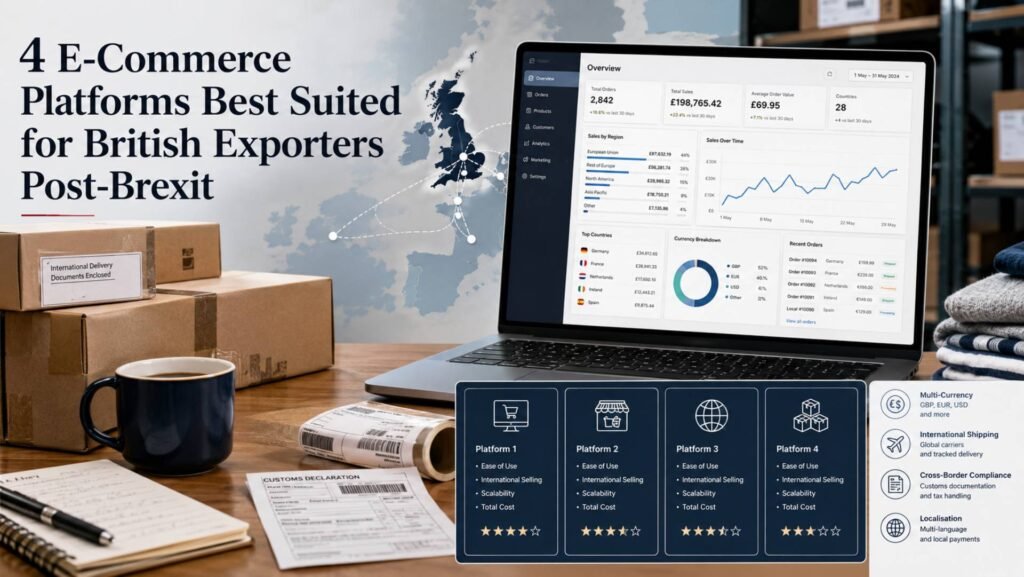
We compared Shopify, BigCommerce, WooCommerce and Adobe Commerce specifically through that post-Brexit lens. Shopify ranks first overall for most exporters, particularly following the UK launch of Managed Markets in July 2026, while the other three have strong cases for businesses with different technical, B2B or enterprise requirements.
Quick Verdict
Best overall: Shopify — 4.7/5
Shopify currently offers the strongest all-round package for a broad range of British exporters because Shopify Markets provides localisation tools and the newly available UK version of Managed Markets can take on much of the operational burden around international duties, taxes and import compliance through a merchant-of-record arrangement.
Best alternative: BigCommerce — 4.3/5
BigCommerce is particularly attractive to established exporters that want native multi-currency support, multiple regional storefronts and considerable control over payments and integrations without moving directly into Adobe Commerce territory.
Key Takeaways
- Shopify is our best overall choice for most UK exporters, driven by Shopify Markets and the July 2026 UK launch of Managed Markets.
- BigCommerce is particularly strong for multi-region operations, with multi-currency support and regional Multi-Storefront capabilities.
- WooCommerce offers the greatest low-cost flexibility, but international selling commonly requires additional plugins and greater technical ownership.
- Adobe Commerce is the strongest specialist enterprise option when a business needs multiple brands, countries, B2B operations, extensive integrations or highly customised commerce workflows.
- No platform removes the need to understand customs, VAT, EORI, commodity codes or rules of origin.
- Headline subscription price is a poor measure of cross-border cost; payment fees, international transaction charges, extensions, tax tooling, development and logistics integrations can matter more.
Editorial Disclaimer
This article provides general editorial information about ecommerce platforms and cross-border selling. It is not tax, customs, accounting or legal advice. VAT, IOSS, customs, origin and import-duty obligations vary according to the seller, product, destination and fulfilment arrangement. Businesses should confirm their obligations with HMRC, the relevant overseas authorities or suitably qualified advisers before trading.
Quick Picks
| Category | Recommended Platform | Why |
| Best overall for UK exporters | Shopify | Strong localisation plus Managed Markets |
| Best for multi-region growth | BigCommerce | Multi-currency and Multi-Storefront architecture |
| Best for flexibility and ownership | WooCommerce | Open-source model and broad extension ecosystem |
| Best for enterprise exporters | Adobe Commerce | Advanced multi-site, B2B and integration capabilities |
Table of Contents
- How We Selected and Rated the Platforms
- E-Commerce Platform Comparison
- Shopify
- BigCommerce
- WooCommerce
- Adobe Commerce
- Real Cost and Value Comparison
- Best Platform by Exporter Type
- What British Exporters Should Check Before Choosing
- Post-Brexit Requirements the Platform Cannot Solve for You
- Final Recommendations
- Frequently Asked Questions
How We Selected and Rated the Platforms
This ranking was built specifically for British businesses exporting internationally rather than for companies selling exclusively within the UK.
The four platforms were selected because they represent different approaches to international commerce: mainstream SaaS, open SaaS, open-source WordPress commerce and enterprise commerce.
We scored each platform from 1 to 5 against six categories.
| Criterion | Weight |
| Cross-border tax, duties and customs support | 25% |
| Localisation, currencies and market management | 20% |
| Shipping and integration flexibility | 15% |
| Ease of operation for UK exporters | 15% |
| Cost and value transparency | 15% |
| Scalability, B2B and complex-commerce capability | 10% |
| Total | 100% |
The ratings are editorial scores calculated from verified platform capabilities and current documentation, not customer-review averages or laboratory test scores.
Weighted Results
|
|
|---|
ResultsWooCommerce narrowly ranks ahead of Adobe Commerce for this article because our audience includes SMEs as well as large exporters. Adobe is considerably stronger for some enterprise requirements, but its implementation demands and lack of public pricing reduce its general suitability.
E-Commerce Platform Comparison
1. Shopify — Best Overall for Most British Exporters
Editor’s rating: 4.7/5
Best for: SMEs and established brands seeking a relatively integrated international-selling system
Starting price: £19/month on annual billing for Basic
Free trial: Shopify currently advertises a three-day free trial followed by a promotional introductory period
Standout feature: Shopify Managed Markets for eligible UK merchants
Main limitation: International transaction, currency and payment costs require careful modelling
Pricing checked: August 24, 2026
Shopify takes our top position because its international commerce proposition changed substantially in 2026. Shopify announced on 15 July 2026 that Managed Markets had become available to UK merchants. The service uses Global-e as merchant of record for eligible international transactions and can handle international tax registration, collection and remittance, tariff classification, duties and import-tax management.
For a British seller that wants EU expansion without building a large internal cross-border compliance operation, that is a significant distinction.
Why We Selected Shopify
Shopify Markets lets merchants organise customers by country or region and adjust currencies, pricing, domains, languages, product availability, themes and taxes for individual markets.
UK businesses can therefore maintain one principal commerce system while presenting a more local buying experience to customers in France, Germany, Ireland, Spain and other markets.
Managed Markets goes further. Shopify says eligible UK merchants can offer duties-inclusive international pricing, local currencies and international tax handling while Global-e acts as merchant of record.
That matters because reducing surprise charges at delivery is one of the central operational challenges in cross-border B2C commerce.
Key Features for UK Exporters
Shopify’s current international toolkit includes market-specific currencies and storefront localisation, local payment methods where supported, regional pricing, translations and duties/import-tax collection.
Merchants collecting duties themselves must still provide suitable customs data. Shopify specifically recommends accurate HS codes and countries of origin because these inputs affect duty calculations.
Shopify Tax can calculate VAT based on registrations and product/customer circumstances, but Shopify is explicit that merchants remain responsible for deciding where registration and collection obligations exist unless another arrangement such as Managed Markets changes the operating model.
Pricing and Real Cost
Shopify’s UK pricing page currently lists annual-billing prices of:
| Plan | Current Annual-Billing Price |
| Basic | £19/month |
| Grow | £49/month |
| Advanced | £259/month |
| Plus | From £1,800/month |
Shopify Payments online standard card rates currently start at 2% + 25p on Basic, with different rates for international cards and higher/lower plans. Using an external payment provider can trigger an additional Shopify transaction fee, ranging from 2% on Basic to 0.6% on Advanced and 0.2% on Plus according to the current UK pricing table.
Managed Markets has another fee structure. Shopify currently lists a 3.5% Managed Markets transaction fee, reduced to 3.25% on Plus, plus currency-conversion and Shopify Payments processing elements. Shopify says international pricing can incorporate these costs into what international customers see.
That makes Shopify easy to start with, but exporters should model the complete economics rather than comparing only the £19 monthly subscription.
Pros and Cons
| Pros | Cons |
| Managed Markets can reduce international compliance administration | Additional international fees can materially affect margins |
| Strong local-currency and regional-market functionality | Some advanced business-entity functionality requires Plus |
| Duties and import taxes can be collected at checkout | HS codes and origin data must still be accurate |
| Relatively easy for non-technical teams to operate | Exporters remain responsible for areas not covered by Managed Markets |
| Strong app, payment and logistics ecosystem | Less architectural freedom than fully open-source platforms |
Who Should Choose Shopify?
Shopify is particularly suitable for UK consumer brands, SMEs and growing DTC retailers that want to enter several European markets without building a custom commerce stack.
It is especially attractive where international selling needs to remain manageable for a relatively lean internal ecommerce team.
Who Should Skip Shopify?
Businesses needing extensive control over infrastructure, unusual checkout logic, highly specialised B2B processes or deeply bespoke enterprise integrations should compare BigCommerce, WooCommerce and Adobe Commerce carefully.
High-volume exporters should also model the effect of international and payment fees before assuming Shopify is the cheapest option.
Editor’s Verdict
Shopify is currently the strongest general recommendation for British exporters because it connects storefront localisation, currencies, tax tooling, duties and international checkout more closely than the alternatives assessed here. The UK launch of Managed Markets in July 2026 strengthens that advantage significantly. Its main weakness is cost complexity: exporters need to calculate transaction economics rather than judging Shopify by its base monthly fee alone.
2. BigCommerce — Best for Multi-Region Growth
Editor’s rating: 4.3/5
Best for: Established brands running multiple regional experiences
Starting price: $29/month billed annually for Core
Free trial: Available
Standout feature: Multi-Storefront combined with strong multi-currency support
Main limitation: Some advanced international functionality becomes more enterprise-oriented
Pricing checked: August 24, 2026
BigCommerce ranks second because its international architecture is particularly well suited to companies that want to run distinct regional commerce experiences from a central backend.
Its current platform supports transactions in more than 100 currencies through suitable payment providers, and its Multi-Storefront capabilities can be used to establish different sites or experiences for individual countries, brands or customer segments.
Why We Selected BigCommerce
BigCommerce’s international proposition is less about outsourcing the cross-border transaction to a merchant of record and more about giving the seller substantial control over localisation.
Its international documentation describes configurations where individual countries can have their own language, currency, payment method, products, prices, promotions and shipping arrangements.
That approach can work well for exporters that have progressed beyond simply sending occasional parcels from Britain and are beginning to operate Europe as a collection of distinct markets.
Key Features
BigCommerce supports transactional and display currencies. Merchants can therefore configure whether a foreign currency is used merely for presentation or is the actual currency charged at checkout, depending on payment-provider support.
Multi-Storefront adds another layer. Individual storefronts can use different domains, currencies, themes, catalogues, pricing and regional content while remaining under central management.
BigCommerce also markets integrations for international tax, shipping and payments rather than attempting to perform every cross-border function itself.
Pricing and Real Cost
BigCommerce changed its plan structure on 1 June 2026.
Current annual-billing prices are:
| Plan | Current Annual-Billing Price |
| Core | $29/month |
| Growth | $79/month |
| Scale | $299/month |
| Performance | Custom, starting at $1,499/month |
Pricing remains shown in US dollars on BigCommerce’s UK-facing pricing information.
The pricing model also uses GMV thresholds. Core is designed for up to $30,000 trailing-12-month GMV, Growth up to $100,000, while Scale introduces a monthly GMV threshold and an overage structure.
Additional storefronts currently start at $30/month on Core, $50 on Growth and $100 on Scale, subject to plan limits.
BigCommerce also introduced Open Payment Provider fees for certain self-service payment configurations in June 2026. Embedded providers avoid those additional platform fees.
Pros and Cons
| Pros | Cons |
| Strong transactional multi-currency functionality | Prices are presented in US dollars |
| Good fit for regional storefront strategies | GMV thresholds complicate long-term cost planning |
| Central management of multiple sites | Advanced international features can require higher tiers |
| Broad payment-provider choice | Cross-border compliance often depends on external integrations |
| Strong B2B and scaling potential | More operational setup than Shopify Managed Markets |
Who Should Choose BigCommerce?
BigCommerce is a strong choice for an established British retailer that already has meaningful international sales and wants individual European storefronts without operating completely separate commerce systems.
It should also appeal to businesses that value payment-provider choice and an open SaaS architecture.
Who Should Skip BigCommerce?
Very small exporters that simply want to begin shipping to two or three EU countries may find its capabilities more extensive than they need.
Companies specifically looking to outsource much of the tax-and-duty transaction layer may find Shopify Managed Markets easier.
Editor’s Verdict
BigCommerce is arguably the strongest option in this comparison for retailers that view France, Germany, Ireland or other countries as separate commercial markets rather than one generic “Europe” region. Its Multi-Storefront and currency architecture are impressive. Shopify stays ahead for our broad exporter audience because it currently provides a simpler route to reducing post-Brexit operational complexity.
3. WooCommerce — Best for Flexibility and Cost Control
Editor’s rating: 3.9/5
Best for: WordPress businesses with technical resources and a preference for ownership and flexibility
Starting price: Free core software
Free plan: Core WooCommerce software is open source and free
Standout feature: Freedom to select hosting, payments and extensions
Main limitation: International capabilities often require several separate components
Pricing checked: August 24, 2026
WooCommerce is structurally different from Shopify and BigCommerce. There is no normal monthly licence charge for the core ecommerce platform and WooCommerce does not take a platform revenue share.
That makes it potentially attractive to exporters that want granular control over their technology stack.
The trade-off is responsibility. Multi-currency, EU VAT workflows, IOSS reporting, hosting, security and shipping integrations may rely on separate plugins or services.
Why We Selected WooCommerce
WooCommerce’s main strength is configurability.
Its official Brexit guidance explicitly covers UK merchants exporting goods to the EU and points exporters towards EORI requirements, customs rules and government export guidance.
WooCommerce Tax supports stores based in the UK and multiple EU countries for automated tax calculations. The company is clear, however, that merchants remain responsible for deciding what taxes they actually need to collect and remit.
Key Features
WooCommerce’s core platform uses a single base currency per store. To let customers transact in multiple currencies, merchants need an extension or plugin.
An official Marketplace option, TIV Multi-Currency, currently costs $149 annually and can allow customers to pay using their selected currency when the chosen payment gateway supports it.
WooCommerce also has an IOSS extension designed to support EU VAT reporting for relevant low-value consignments. Its current Marketplace price is $49 per year.
For B2B exports, the EU VAT Number extension can collect and validate EU VAT numbers and apply appropriate VAT handling within the store configuration.
This modularity is valuable, but it demonstrates why “WooCommerce is free” does not equal “international ecommerce is free”.
Pricing and Real Cost
WooCommerce lists:
- Core platform: free
- Platform revenue share: 0%
- Typical hosting: 25–350 per month for many stores
- Extensions: commonly 29–299 per year each
These are WooCommerce’s own indicative figures rather than fixed costs every retailer will pay.
A British exporter might then add multi-currency functionality, EU VAT tools, IOSS reporting, international shipping software, security services, backups and developer support.
The resulting annual cost can still be competitive, particularly for technically capable businesses, but it depends heavily on the stack chosen.
Pros and Cons
| Pros | Cons |
| Free open-source core | International setup can become plugin-heavy |
| No WooCommerce platform revenue share | Merchant owns more technical maintenance |
| Broad payment-gateway freedom | Native core supports only one base currency |
| Highly customisable tax and checkout workflows | Plugin compatibility needs management |
| Very large WordPress ecosystem | Security, hosting and performance require attention |
Who Should Choose WooCommerce?
WooCommerce works particularly well for UK businesses already running WordPress, companies with reliable developer support and exporters that want to control exactly which tax, payment, fulfilment and currency tools they deploy.
It is also attractive when avoiding SaaS platform transaction surcharges is a major commercial priority.
Who Should Skip WooCommerce?
Businesses without technical support should be cautious.
A plugin-based international setup can provide extensive control, but that control creates maintenance responsibilities. A retailer that wants one vendor to handle more of the cross-border operating model will probably prefer Shopify.
Editor’s Verdict
WooCommerce remains one of the strongest UK e-commerce platforms for merchants who value ownership and technical flexibility. It loses ground in this post-Brexit comparison because several important exporter capabilities are modular rather than tightly integrated. For the right technical team, that is a feature; for a lean SME, it can become an operational burden.
4. Adobe Commerce — Best for Complex Enterprise Exporters
Editor’s rating: 3.9/5
Best for: Large exporters, B2B companies and complex multi-brand businesses
Starting price: Not publicly disclosed; request a quote
Trial: Contact Adobe
Standout feature: Enterprise-scale multi-site and multi-market architecture
Main limitation: Cost and technical complexity
Pricing checked: August 24, 2026
Adobe Commerce is not the natural starting point for most small British exporters, but it is difficult to ignore at enterprise scale.
Adobe’s current architecture supports multiple websites, stores and store views under one installation. Different views can be used for languages and currencies, while websites and stores can support distinct catalogues, domains and market configurations.
Why We Selected Adobe Commerce
Adobe positions Commerce for global B2C and B2B organisations managing multiple brands, storefronts and countries.
Its current global-commerce material highlights support for multiple languages, currencies, inventory locations and tax policies, with regional payment and shipping customisation through integrations.
This makes it particularly relevant to large British manufacturers, wholesalers and retailers that sell into multiple EU countries while operating complex ERP, PIM, CRM or fulfilment environments.
Key Features
Adobe Commerce can support multiple websites from a single installation, with individual stores and store views under each website.
Adobe describes its current platform as capable of supporting large catalogues, global expansion, localised storefronts, B2B commerce, tax and shipping management and API-first integrations.
The model is very powerful when a retailer needs separate experiences for France, Germany, Spain and the UK while sharing parts of the same technology and product-data foundation.
Pricing and Real Cost
Adobe does not currently publish a standard Adobe Commerce licence price on its official pricing page. Both Adobe Commerce as a Cloud Service and Adobe Commerce on Cloud require prospective customers to request pricing.
That means an evidence-based article should not invent a £ or $ starting price.
Licence cost is only part of the equation. Enterprise Adobe Commerce implementations commonly require development, integration, deployment, testing, maintenance and specialist technical support.
The absence of a public rate card materially reduces price transparency compared with the other three platforms.
Pros and Cons
| Pros | Cons |
| Excellent multi-site and multi-market architecture | Pricing is not publicly disclosed |
| Very strong B2B capabilities | Significant implementation complexity |
| Suitable for enormous catalogues | Usually excessive for smaller exporters |
| Broad integration and API capabilities | Specialist development resources are commonly required |
| Highly configurable regional storefronts | Higher likely total ownership burden |
Who Should Choose Adobe Commerce?
Adobe Commerce makes sense for large British exporters where ecommerce is integrated into a broader enterprise architecture.
Typical candidates include multi-brand retailers, manufacturers with B2B and B2C channels, companies with complex catalogues and businesses needing deeply integrated ERP, inventory, product-information and customer systems.
Who Should Skip Adobe Commerce?
Most small and medium-sized exporters should start elsewhere unless their technical or commercial requirements clearly justify enterprise architecture.
Complexity is valuable only when a business actually needs it.
Editor’s Verdict
Adobe Commerce is the most capable specialist platform in this comparison for extremely complex international operations, but it is not our general winner. Its enterprise flexibility comes with greater implementation demands and weaker cost transparency. For large organisations that genuinely need that architecture, its fourth-place overall ranking should not be interpreted as a sign that it is technically inferior.
Real Cost and Value Comparison
No responsible universal annual-cost figure can be given because payment volume, average order value, destination countries, payment mix, apps, development and international sales volume materially change the result.
For exporters, model at least:
Platform + payment processing + cross-border transaction fees + currency conversion + tax/duty solution + extensions + development + shipping/fulfilment integrations + support.
Best Platform by Exporter Type
| Exporter / Business Type | Recommended Platform | Why |
| Small UK brand entering the EU | Shopify | Easiest overall cross-border operating model |
| DTC company wanting duties-inclusive international checkout | Shopify | Managed Markets is particularly relevant |
| Mid-market retailer launching individual country stores | BigCommerce | Strong Multi-Storefront architecture |
| WordPress retailer with developers | WooCommerce | Maximum flexibility and ownership |
| Exporter wanting payment-gateway freedom | WooCommerce / BigCommerce | Greater processor choice without the same Shopify model |
| Large B2B exporter | Adobe Commerce | Complex B2B and integration capabilities |
| Multi-brand multinational retailer | Adobe Commerce | Strong central multi-site architecture |
| Business prioritising lowest initial software fee | WooCommerce | Free core software, though other costs remain |
What British Exporters Should Check Before Choosing a Platform
EU VAT and Import VAT
Exports of goods from the UK to customers outside the UK can generally be zero-rated for UK VAT when the relevant conditions and evidence requirements are met. HMRC requires exporters to retain appropriate evidence that goods have left the country.
That does not mean the transaction is tax-free. Import VAT and, depending on the shipment and origin, customs duties may arise in the destination country.
The checkout experience should make it clear whether these costs are prepaid or collected from the customer later.
IOSS for Low-Value Sales
HMRC’s current 2026 guidance allows eligible businesses to use the VAT Import One Stop Shop scheme for qualifying goods sold to consumers in the EU, Northern Ireland or both when consignments are £135 or less under the UK scheme guidance.
Your platform must therefore work with whichever IOSS, merchant-of-record, tax intermediary or direct-registration approach your advisers determine is appropriate.
Duties at Checkout
Unexpected import bills are poor customer experience.
For exporters using delivery-duty-paid models, the ecommerce stack needs accurate HS codes, country-of-origin information and integrations capable of transferring customs data correctly.
Shopify can collect duties and import taxes at checkout where requirements are satisfied, although its standard calculation remains dependent on accurate merchant data.
Comparable workflows on WooCommerce, BigCommerce and Adobe Commerce can be constructed, but third-party services may form a larger part of the solution.
Local Currencies
A European expansion strategy should normally allow customers to see and, where commercially appropriate, transact in local currencies.
Shopify and BigCommerce have strong native capabilities here. WooCommerce requires an extension for multi-currency transactions because the core store uses one base currency.
Regional Storefronts
There is a major strategic difference between:
“We ship from Britain to Germany”
and:
“Germany is one of our core ecommerce markets.”
The second situation may justify:
- German-language content;
- EUR pricing;
- local payment options;
- local delivery promises;
- regional product availability;
- country-specific promotions;
- market-specific SEO;
- local returns processes.
BigCommerce and Adobe Commerce are particularly strong when operations reach this level of regional differentiation.
Technical Resources
Do not choose enterprise flexibility if nobody in the business can maintain it.
Shopify generally requires the least technical ownership of the four.
WooCommerce transfers much more responsibility to the merchant and its developer/hosting partners.
Adobe Commerce normally requires specialist expertise.
BigCommerce sits between these models.
Post-Brexit Requirements Your E-Commerce Platform Cannot Solve for You
Choosing better ecommerce software does not eliminate the customs border created by Brexit.
A Great Britain business moving goods internationally may need a GB EORI number, and exports generally require customs declarations.
Goods must also be classified correctly. Commodity codes affect customs treatment, and exporters seeking preferential tariff treatment under the UK-EU Trade and Cooperation Agreement must determine whether their goods satisfy the relevant rules of origin.
The trade agreement does not mean every product shipped from Britain to the EU is automatically duty free. Zero-tariff preference depends on qualifying origin. Goods that do not satisfy those rules can still be exported but may face the EU’s applicable non-preferential tariff.
Platform choice should therefore be made alongside decisions about:
- customs representation;
- EORI registration;
- VAT/IOSS strategy;
- commodity classification;
- origin evidence;
- delivery terms;
- DDP versus other shipping arrangements;
- fulfilment locations;
- returns;
- EU product and consumer regulations applicable to the goods.
For businesses moving goods from or through Northern Ireland, separate Windsor Framework and related rules may apply, so Great Britain guidance should not automatically be applied to those movements.
Common Questions Answered
What is the best e-commerce platform for UK exporters in 2026?
Shopify is our best overall choice for most British exporters. Its Shopify Markets functionality and the July 2026 UK launch of Managed Markets provide a particularly strong combination of regional localisation, local currencies, duties, tax management and international checkout support.
Is Shopify or WooCommerce better for selling from the UK to Europe?
Shopify is generally easier for businesses that want more cross-border functionality managed within one ecosystem. WooCommerce provides greater technical and payment flexibility but normally requires more extensions and maintenance for multi-currency and specialist EU VAT workflows.
Do I need an EORI number to sell products from the UK into Europe?
A business exporting goods from England, Scotland or Wales generally needs a GB EORI number for customs activities. Northern Ireland circumstances can require different arrangements.
Are UK exports to the EU automatically tariff-free after Brexit?
No. To obtain preferential zero-tariff treatment under the UK-EU Trade and Cooperation Agreement, goods must satisfy the applicable rules of origin. Goods that do not qualify can be subject to normal EU import tariffs.
Can an ecommerce platform deal with EU VAT for me?
Platforms can calculate and collect taxes when configured correctly, but normal software functionality does not automatically remove the merchant’s legal obligations.
Shopify Managed Markets is different because eligible international transactions use a merchant-of-record model under which Global-e handles relevant international tax registration, collection and remittance.
What is IOSS?
The Import One Stop Shop is a VAT scheme intended to simplify VAT collection and reporting for qualifying low-value goods sold to consumers. HMRC’s current UK IOSS scheme guidance covers eligible imported consignments valued at £135 or less for consumers in the EU, Northern Ireland or both.
Is WooCommerce really free?
The WooCommerce core software is free and open source, with no WooCommerce platform revenue share. A working exporter store still needs hosting and may require paid extensions, payment processing, development, security, international tax and currency functionality.
Which platform is best for a large UK exporter?
Adobe Commerce becomes especially attractive for complex enterprises managing numerous websites, countries, brands, B2B customers and integrations. BigCommerce is another strong option for substantial international businesses that want multi-store functionality with a SaaS operating model.
Final Recommendations
Choose Shopify if you are a small, medium-sized or growing British retailer and want the most integrated route into cross-border ecommerce. Its combination of Markets and the 2026 UK introduction of Managed Markets earns it first place.
Choose BigCommerce if you already operate at meaningful scale and want different storefront experiences for individual markets while retaining substantial payment and integration flexibility.
Choose WooCommerce if you have reliable WordPress expertise, want maximum control over the stack and are comfortable assembling the international functionality you require through extensions and services.
Choose Adobe Commerce if you are operating a complex enterprise environment with multiple brands, countries, B2B operations, systems and specialised workflows.
There is no universally correct ecommerce platform. For British exporters after Brexit, the strongest choice is the one that reduces the specific cross-border friction your business actually faces without creating unnecessary cost or technical complexity.
For most SMEs and growing consumer brands in 2026, that balance currently favours Shopify.